Conservatory and Garden Room Rugs: Sunlight, Damp and Temperature
Conservatories and garden rooms are among the most-used and least-considered rooms in British homes. They get furnished last, often with whatever was left over, and the rug is usually an afterthought — which is a shame, because the conditions in a glass room are genuinely unlike anywhere else in the house.
Three things are working against a rug in there: far more ultraviolet light than any other room receives, a temperature range that can swing twenty degrees in a day, and moisture that appears from nowhere on a cold morning. A rug that is perfect in a living room can look tired in a conservatory within two summers.
The Sunlight Problem
Glass does not stop ultraviolet light in any meaningful way, and a conservatory is essentially a room built out of windows. Over a season, that light does two things. It fades dyes, and it degrades fibres.
Fading is the obvious one. Natural dyes and richly coloured wool lose depth first, and reds and deep blues tend to go before neutrals and greys. What makes it look worse than ordinary wear is that it is not even — the sun reaches part of the floor and not the rest, so you end up with a bleached patch and a hard line where the shadow of the frame or a piece of furniture fell.
The second effect is less visible until it matters. Prolonged UV exposure makes wool fibres brittle, so a rug that has spent years in direct sun can start shedding and breaking at the surface even where it has not been walked on much. Silk and viscose are worse still, and are best kept out of a glass room entirely.
Damp, Condensation and Cold Floors
The second issue is water. A conservatory heats up quickly during the day and loses that heat just as quickly overnight, and when warm interior air meets cold glass you get condensation. In winter it runs down the panes and pools at the foot of the frame, exactly where the edge of a rug tends to sit.
A rug that stays slightly damp for weeks is a rug that will smell, and in a natural fibre it is a rug that will eventually rot at the backing. This is the reason jute and seagrass, which are otherwise so well suited to a relaxed garden room, are a poor bet in a conservatory that condenses — they absorb moisture readily and are slow to give it back.
The floor itself adds to the problem. Most conservatories are laid with tile or laminate over a slab, with limited insulation beneath, so the floor is cold for most of the year. Cold floors encourage condensation, and they are the main reason a conservatory feels unwelcoming in February even when the room itself is warm.

What Actually Works
Solution-Dyed Polypropylene
This is the single most useful thing to know about conservatory rugs. In solution-dyed fibre the colour is added to the polymer before the yarn is extruded, so it runs the whole way through rather than sitting on the surface. The practical result is a rug that resists fading far better than a piece-dyed wool or a viscose, and one that is unbothered by getting wet and drying out again.
Outdoor-Grade Rugs Used Indoors
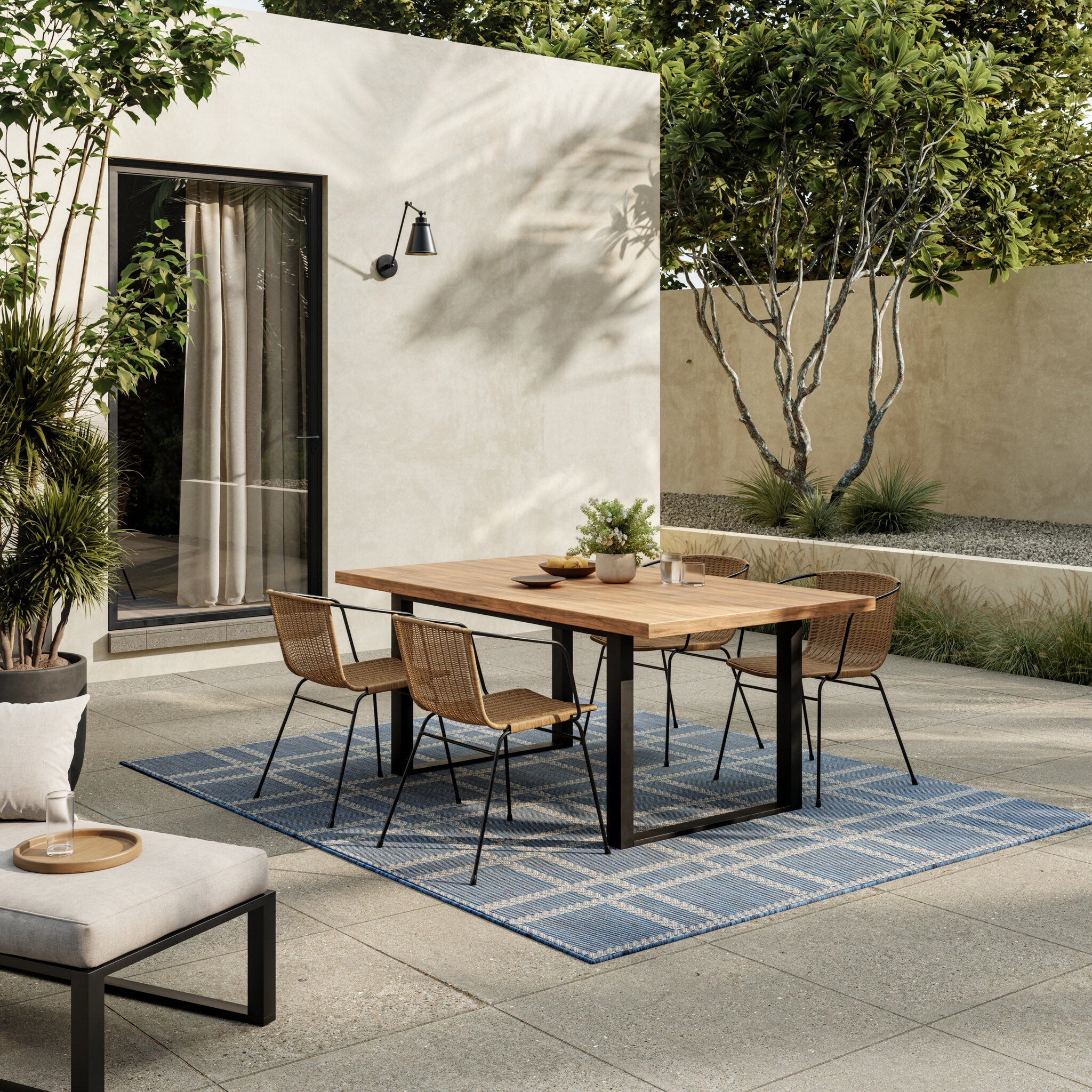
An outdoor rug indoors is a legitimate and badly underused choice for this room. Outdoor rugs are built for precisely the conditions a conservatory creates — sustained sunlight, moisture, temperature swings — and the current generation looks nothing like the plastic matting people remember. Many are woven in convincing flatweave and textured designs, and they can simply be taken outside and hosed down when they need it. If your garden room opens onto a patio, using the same rug design on both sides of the doors also makes the two spaces read as one.
Flatweaves
Whatever the fibre, a flatweave has a real advantage here: with no pile to hold water, it dries in hours rather than days. A flatweave also lies flat under a door that opens inwards, which is a common practical constraint in a conservatory.
Looking After a Rug in a Glass Room
Two habits will roughly double the life of any conservatory rug.
- Rotate it 180 degrees every three or four months. Fading is inevitable; a hard line between a faded half and an unfaded half is not. Rotating spreads the exposure so the rug ages evenly and the change is almost impossible to see.
- Lift and air it in winter. If condensation is running down the glass, take the rug up on a dry day, stand it somewhere ventilated for a few hours and let the floor dry properly before it goes back down. Ten minutes of effort twice a winter prevents the musty smell that otherwise arrives in spring.
One more practical point: tile and laminate are slippery, and a rug on either needs a non-slip underlay. Choose one rated for damp conditions rather than a felt pad, which will hold moisture against the floor.
Making the Room Warmer
The rug is also your cheapest fix for the cold-floor problem. Covering a good portion of the tiles breaks the direct contact between feet and slab, and a slightly larger rug than the room seems to call for does more for the temperature than a small one floating in the middle. Anchor it under the seating so the area you actually sit in is the area that is covered.
Conservatory Rugs at Kelaty
For a glass room, Kelaty's outdoor range is usually the sensible starting point — colourfast, quick-drying and easy to clean, in designs that sit comfortably indoors and can be taken outside and hosed down when they need it. Browse the outdoor rug range.