Article: Colour Drenching: How to Choose a Rug for a Tonal Room
Colour Drenching: How to Choose a Rug for a Tonal Room
Colour drenching is one of the defining interior ideas of recent years. Instead of painting walls one colour and woodwork another, the whole room is wrapped in a single hue: walls, skirting, doors, radiators, sometimes the ceiling too. Done well, it makes a room feel enveloping, calm and surprisingly spacious, because the eye no longer stops at every edge.
But a drenched room raises a question on the floor. Should the rug match, contrast, or sit somewhere in between?
Option one: go tonal
The most immersive approach is a rug in a lighter or darker version of the wall colour. Sage walls with a deeper olive rug; dusky blue walls with a navy rug; plaster pink walls with a berry rug. The room reads as one continuous, considered whole.
The key is variation. A rug that is exactly the wall colour can make the room feel flat. Look for a design with two or three shades of the same family, a tonal pattern, or varied pile heights that catch the light. Browse our green, blue and teal and pink, berry and purple collections for tonal options.
Option two: ground it with a neutral
If you love the colour on the walls but want the room to feel a little lighter, a neutral rug gives the eye somewhere to rest. Warm neutrals such as oatmeal, camel and soft brown suit most drenched schemes better than cool grey, which can look flat against strong colour. See our beige and cream and brown ranges.
Option three: a considered contrast
For something bolder, choose a rug that introduces one complementary colour. A rust or terracotta rug in a deep green room; ochre in a blue room; a soft green in a pink room. Keep the contrast to one colour, and ideally let it echo something else in the room, such as a cushion, a picture or a lampshade.
Our guide to choosing a rug colour covers the principles of contrast in more detail.
Pattern in a drenched room
A single-colour room is a wonderful backdrop for pattern, because there is nothing competing with it. A patterned rug in colours drawn from the walls can become the focal point of the room. If you are also using patterned curtains or upholstery, vary the scale: one large pattern, one small, one plain. Our piece on mixing patterns explains how.
Practical points
- Test in the room. Paint colours shift dramatically with daylight, and so do rugs. Look at samples and swatches in the actual space, morning and evening.
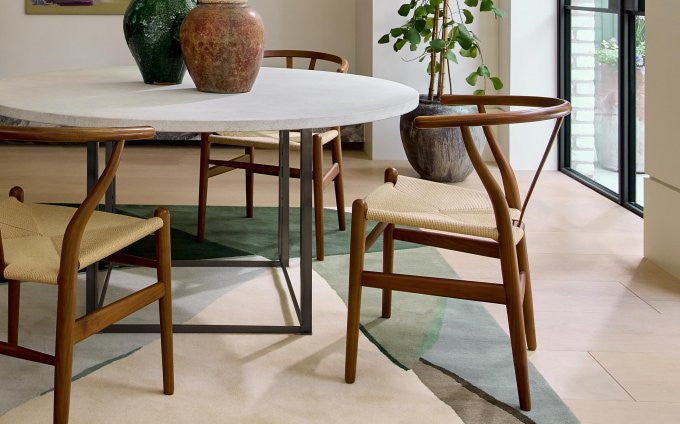
- Consider the floor too. A rug sits on timber, stone or carpet, and that surface is part of the palette.
- Size generously. In a drenched room, a small rug can look like an island. Allow the rug to sit under the front legs of the main furniture at least. Our rug size guide will help.
A decorator's note
In a colour-drenched room the rug is often the last decision and the most important one. It sets the depth of the scheme. If you have a paint colour in mind, tell us the shade and we can suggest rugs that will sit comfortably with it.