Fringes, Borders and Backings: How to Read a Rug's Construction
Two rugs can look almost identical face up and be entirely different objects. One may be knotted by hand on a warped loom over several months; the other may be woven by machine in an afternoon, or tufted with a hand-held gun and held together with latex. None of that is visible in a photograph, and not all of it is visible from above.
It is, however, easy to read once you know the three places to look — the fringe, the edges and the back. It takes about thirty seconds in a showroom and tells you what you are actually buying.
Start With the Fringe
On a hand-knotted rug, the fringe is not decoration. It is the warp — the foundation threads strung the length of the loom, around which every knot in the rug is tied. What you see at either end are simply those warp threads emerging from the weave and finished off. The fringe is structurally continuous with the rug. It is, in a real sense, the rug.
On many machine-made rugs the fringe is added afterwards: a band of tassels stitched onto the finished edge because buyers associate fringes with hand-made pieces. It performs no structural role.
Telling them apart is straightforward. Look at the point where the fringe meets the pile, on the back as well as the front. On a hand-knotted rug the threads run continuously out of the body of the weave with no join. On a sewn-on fringe you will see a seam — a line of stitching, or a narrow bound band, where the tassels have been attached. A very gentle pull confirms it: a warp fringe is anchored to the whole rug, while a sewn one moves against the seam.
This matters most when a fringe starts to fray, which every fringe eventually does. On a sewn-on fringe, fraying is cosmetic. It can be trimmed, re-stitched or removed entirely without touching the rug. On a hand-knotted rug a damaged fringe means exposed warp ends, and left alone the knots at the end of the rug begin to release. That is a job for a specialist, and it is far cheaper to secure the ends early than to have rows of knots rewoven later.
Selvedges and Edge Finishes
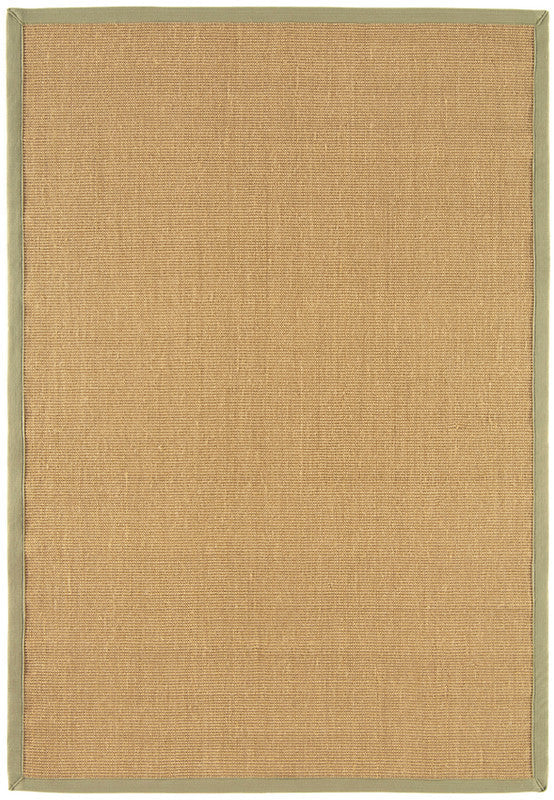
The long sides of a rug are the selvedges, and they are finished in one of two ways. Hand-overcasting wraps yarn — usually wool, sometimes cotton — tightly around the outermost warps by hand, so the edge is continuous with the foundation and has the very slight irregularity of anything done by hand. Machine serging is a row of even overlock stitching in thread, applied after weaving. Binding, a folded fabric tape sewn over the edge, is common on cut-to-size pieces and on rugs made from broadloom carpet.
All three are legitimate, all three are repairable, and the edge is where a rug usually fails first. A loose serged edge caught by a vacuum will run for half a metre in seconds, so keep the vacuum head away from the edges.

Turn It Over
The back is the most honest part of any rug.
Hand-Knotted
The pattern reads clearly through to the reverse, slightly softened but entirely legible, and you can see the individual knots as small nodes in regular rows. Count them across a centimetre and you have the knot density. There is no backing material, and there will be small irregularities — a row slightly tighter than its neighbour, a colour shifting subtly across a band where a new batch of yarn was introduced. Those are evidence, not faults.
Hand-Tufted
The pattern is hidden. A hand-tufted rug is made by punching yarn through a stretched backing cloth, then locking it in place with latex adhesive and covering the whole reverse with a canvas scrim. If you turn a rug over and see plain fabric with no pattern showing through, it is hand-tufted. These can be excellent rugs, and they are often how a good pattern reaches a sensible price, but the latex is a finite component — over many years it hardens, and the rug will not take the kind of restoration a knotted piece does.
Machine-Woven
The pattern shows through, as on a knotted rug, but with machine regularity: perfectly even rows, no variation, and often a visible woven ground of cotton or polypropylene. The precision is the tell. Nothing made by hand is that consistent.
Weight and Handle
Pick a corner up. A hand-knotted wool rug is dense and heavy but flexible — it folds and drapes over your arm. A hand-tufted rug is stiffer and resists folding because of the latex layer. A flatweave is light and floppy and reversible. A heavily backed machine-made rug can feel almost board-like. Handle also tells you how the rug will behave in the room: a stiff rug will not lie flat over an uneven floor, and a very light one needs an underlay to stay put.
What None of This Settles
It is tempting to read this as a ranking, with hand-knotted at the top. It is not one. A well-made machine-woven rug in a good heat-set yarn, at high density, will comfortably outlast a poorly made hand-knotted rug with a low knot count and fugitive dyes. Handwork guarantees nothing on its own; it is one variable among several, alongside fibre quality, density, dye quality and finishing.
What construction does tell you is what you are paying for, how long the rug should reasonably last, whether it can be repaired, and how it should be cleaned. Those are the useful questions. Whether the rug is right for your room is a matter of colour, scale and pattern, and no amount of knot counting will answer it — as anyone who has fallen for a simple flatweave over a far more expensive knotted piece knows.
Caring for Fringes and Edges
Never run a beater bar over a fringe. It is the most common way fringes are destroyed, and it takes one pass. Vacuum away from the fringe rather than into it, or lift the head and use the hose. Comb tangled fringes straight with your fingers or a wide-toothed comb, working from the tips back rather than dragging outwards from the base. Do not let a fringe sit folded under the rug for months. And if you see a fray beginning, deal with it while it is a fray.
Understanding What You Own
Kelaty's ranges span hand-knotted, hand-tufted, flatwoven and machine-woven construction, and each is listed with its specification so you can see what a rug is before you buy. To compare constructions side by side, start with the Oriental & Traditional range.