Designer Rugs: What You're Actually Paying For
Put a designer rug next to an unbranded one of similar size and construction and the difference in price is real. It is a fair question to ask what that difference represents, and the honest answer is that some of it buys things you can see and use, and some of it buys things that matter only if you happen to care about them.
What follows is an attempt to separate the two, without either dismissing the premium or pretending it is always justified.
What the Money Buys
Original Design
Most of the rug market is derivative, and openly so. A pattern succeeds somewhere, it is copied, and the copy is copied — each time slightly coarsened, with colours drifting and details dropping out, until what reaches the floor is a fourth-generation version of something that was once considered. It is not dishonest, and some of the results are perfectly pleasant, but the design work happened elsewhere and long ago.
A designer rug is drawn. Someone worked out the scale of the repeat, the relationship between the motif and the ground, where the pattern should breathe and where it should crowd, and how the whole thing reads on a floor rather than on a screen. That development is expensive and it is genuinely visible — usually in the confidence of the drawing and in the way the design holds together at a distance as well as up close.
Archive Access
The heritage houses hold something that cannot be bought or recreated: pattern books going back well over a century, full of documents, colourways and printing blocks. When Morris & Co or Sanderson issues a rug, it is generally drawn from an original document rather than approximated from a photograph of one, and the difference shows in the small things — the way a leaf turns, the density of a background, a colourway that looks unfamiliar because it is the original one rather than the one everybody else has copied.
Colour and Dye Quality
Colour control is one of the least glamorous and most consequential parts of rug production. Getting a specific shade consistent across an entire production run, then getting it to stay that shade after five years beside a south-facing window, requires dye quality and quality control that cost money. Brands whose reputation rests on colour tend to specify tightly and reject batches that drift. This is a large part of what you are paying for, and it is the part you notice years later rather than on the day.
Specified Yarn
An unbranded rug is often made to a price, which means the yarn is whatever meets the specification most cheaply at the time of production, and it can change between runs. A designer range typically specifies the fibre, the blend, the twist and the pile weight, and holds to it. That does not automatically make it better than a good unbranded rug — but it does make it predictable, which is worth something when you are buying without handling the piece first.
Consistency and Risk
Finally, the brand carries the risk. If a batch comes out wrong, it is the brand's name on it, and the batch does not ship. Part of the premium is simply the cost of that discipline, and of the returns and remakes that go with taking responsibility for the finished article.

What It Does Not Buy
A designer name does not, by itself, guarantee better construction. A branded hand-tufted rug and an unbranded hand-tufted rug can come from comparable factories with comparable specifications. The design will be better resolved and the colour more carefully controlled, but the pile weight, the density and the backing may be much the same.
So read the specification rather than the label. Look at the fibre, the construction, the pile height and the weight, exactly as you would on an unbranded rug, and judge durability on those. If a designer rug and a plain one carry the same specification, expect them to wear the same way. You are paying for the drawing and the colour, not for a different order of robustness — and it is worth knowing that, so that you are paying it deliberately.
The Coordination Advantage
There is one practical benefit of designer rugs that is often overlooked and is, for some rooms, the strongest argument of all.
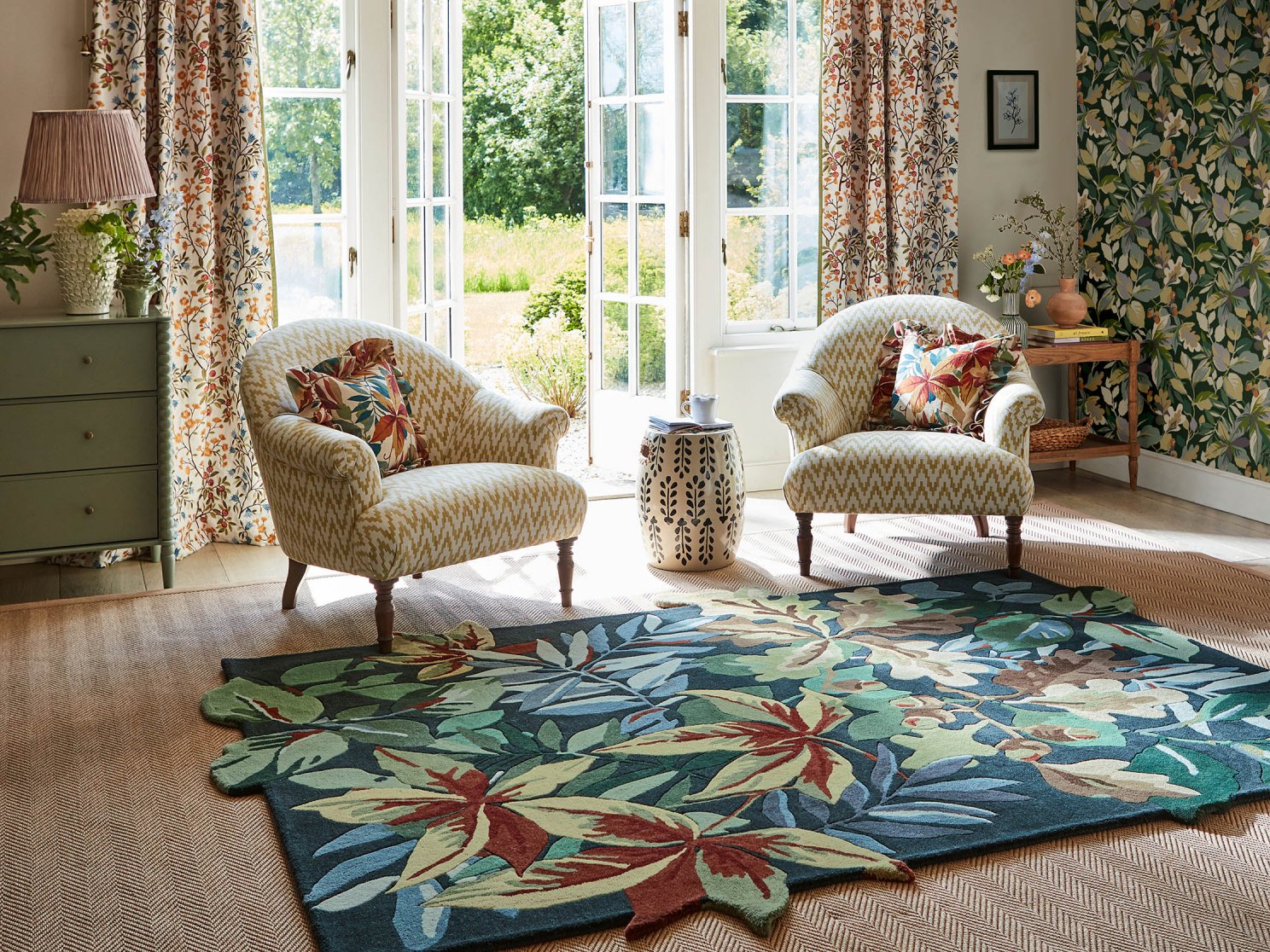
Most of these houses are not rug companies. They are pattern companies that also make rugs, alongside fabrics, wallpapers, cushions and paint. Everything within a collection is drawn from the same designs and matched to the same colour palette, which means a rug, a curtain fabric and a wallpaper from the same house will sit together without any effort on your part.
Anyone who has tried to match a rug to a wallpaper by eye, across two shops and a colour-shifted screen, knows how difficult this is. Scheming a room around a single house removes that problem entirely. It is not a small advantage — it is the difference between a room that hangs together and one that is almost right in a way you never quite stop noticing.
When It Is Worth It
A designer rug earns its premium when the pattern is the point. If the rug is the thing people will look at, if it needs to hold a room on its own, or if it has to coordinate precisely with other elements you have already chosen, the design work is exactly what you are buying and it is money well spent.
It is less compelling when the rug is essentially background — a large plain in a busy family room, a practical piece under a dining table, something that needs to disappear. There, specification is everything and the name adds little you will benefit from.
Designer Rugs at Kelaty
Kelaty carries several of the houses worth knowing, spanning fashion, heritage and contemporary print — Calvin Klein, DKNY, Harlequin, Sanderson, Morris & Co, Laura Ashley, Orla Kiely, Marimekko, Wedgwood and Scion. Each is listed with its full specification alongside the design. Browse the International Designers range.