Hand-Knotted, Hand-Tufted or Machine-Woven: How Rugs Are Made
Two rugs can sit side by side on a showroom floor, share a pattern, share a palette, share a pile height — and differ in price by a factor of twenty. The difference is almost never in the drawing. It is in how the rug was made.
Three constructions account for the overwhelming majority of rugs sold in the UK: hand-knotted, hand-tufted and machine-woven. Each takes a different amount of time to produce, costs a different amount, lasts a different length of time, and does a different set of jobs well. Being able to tell which one you are looking at — from the rug itself rather than from the label — is probably the most useful skill a rug buyer can acquire.
Hand-Knotted: The Oldest Method
A hand-knotted rug is built, not applied. The weaver strings vertical warp threads on a loom, then ties individual knots of pile yarn around pairs of those warps by hand, row by row, packing each row down with a comb and locking it in place with horizontal weft threads. When the rug is cut from the loom it is essentially finished. The pile, the foundation and the structure are one interlocked textile with nothing holding them together but the weave itself.
That is why a hand-knotted rug has no backing. There is no glue, no scrim, no secondary layer — only the reverse face of the same cloth. It is also why these rugs last. A well-made hand-knotted piece that is rotated, vacuumed sensibly and kept out of standing water can be handed down through several generations, and the antique trade exists precisely because they survive that long.
The cost follows from the labour. A skilled weaver ties a few thousand knots in a working day, and a room-sized rug of moderate density runs to well over a million knots. A 170 x 240cm rug therefore represents months of continuous work by one or more weavers, and a finely knotted piece can take a year or more. Knot density is quoted per square inch even in metric markets, which is a quirk of the trade rather than a slip: broadly, higher density means finer detail and more hours in the piece.
Hand-Tufted: The Practical Middle
Hand-tufting is a twentieth-century shortcut, and a genuinely clever one. The design is printed onto a canvas stretched on a frame, and a worker uses a handheld tufting gun to punch loops of yarn through the canvas from behind, following the printed lines. The loops are then sheared to create a cut pile.
At that point nothing is holding the yarn in — so a coat of latex adhesive is spread across the back to lock the tufts, and a second canvas backing is glued over the top to hide it. This is the crucial detail. A hand-tufted rug is a composite: pile, glue, cloth. It can be produced in a few days rather than a few months, which is why it costs a fraction of a knotted rug while still being made by hand, and why it is the construction behind most of the thick, soft, contemporary designs on the market.
The trade-off is lifespan. Latex is an organic material and it ages. Depending on the quality of the adhesive, the humidity of the room and how much wet cleaning the rug endures, expect roughly 10–20 years before the backing begins to dry out, powder and separate. A hand-tufted rug is a good fifteen-year rug. It is not an heirloom, and it should not be bought as one.

Machine-Woven: Speed and Consistency
A power loom weaves pile and foundation together in a single mechanical pass, driven by a computerised pattern file. What takes a weaver six months takes the loom under an hour. The yarn is usually heat-set polypropylene or polyester, sometimes wool or a wool blend, and the result is flawlessly regular — every repeat identical, every edge straight.
Machine-woven rugs are the workhorses. They are colourfast, generally stain-resistant, easy to replace and priced so that you can change your mind in five years without regret. Because the pile is woven into the ground weave rather than glued to it, there is no adhesive layer waiting to fail, though the fibres themselves will flatten and dull with heavy traffic. Ten years of ordinary domestic use is a reasonable expectation, longer in a low-traffic room. Many contemporary designs are produced this way and look excellent doing it.
How to Tell Them Apart
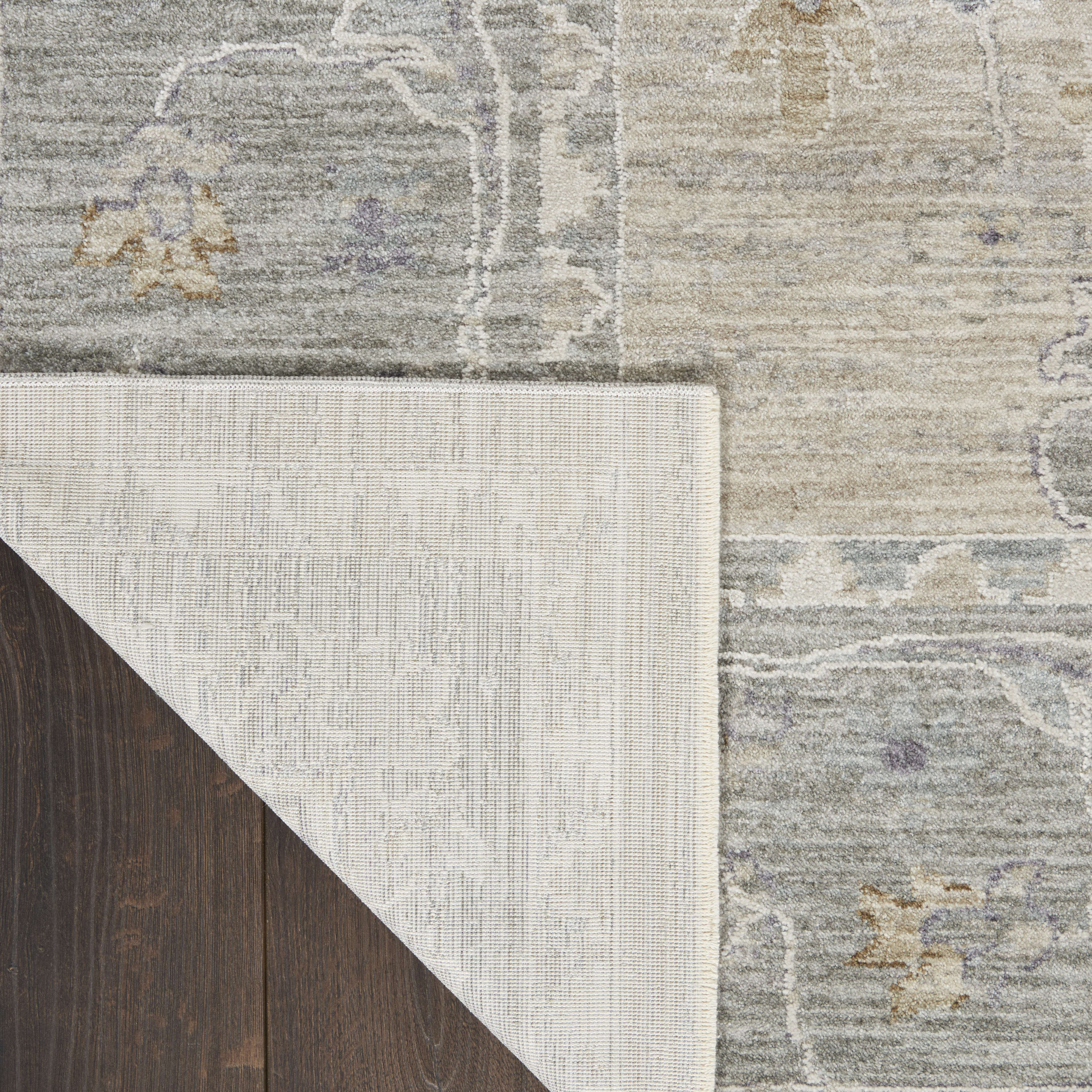
Turn the rug over. On a hand-knotted rug the pattern appears on the back with almost the clarity of the front, slightly irregular, and the fringe is a continuation of the warp threads running out of the rug rather than a strip stitched on. On a hand-tufted rug you see no pattern at all — just a plain fabric backing glued flat, with any fringe obviously sewn to the edge. On a machine-woven rug the pattern is visible on the back but mechanically perfect, often with fine horizontal tramlines and a machine-overlocked edge.
Then do the fold test. Fold a corner back on itself so the pile parts and you can see down to the base. On a hand-knotted rug you will see individual knots collared around the warps in neat rows, each one a tied node. On a hand-tufted rug you will see U-shaped tufts standing in a bed of dried adhesive. On a machine-woven rug the yarn runs continuously and disappears into the weave. Thirty seconds and a corner of the rug will tell you more than any product description.
Flatweaves are the fourth category and sit outside this comparison entirely: they have no pile at all, being woven face and back alike, which is why kelims and flatweaves feel and behave so differently underfoot.
Which One Should You Buy
Buy hand-knotted when the rug is meant to outlast the room it is going in, when you want a piece with a resale market behind it, and when the budget allows — this is the only one of the three with a meaningful secondary value. Buy hand-tufted when you want depth, softness and a designer look at a sane price, and you are content with a good long chapter rather than a whole book. Buy machine-woven for children’s rooms, kitchens, rented flats, high-traffic hallways, and anywhere the rug has to earn its keep and be replaceable.
Construction at Kelaty
Every Kelaty listing states the construction and the fibre, so you can compare like with like before you compare prices. If you are drawn to the hand-knotted tradition in particular, the Oriental and Traditional range is the place to start.