Round Rugs: Where They Work and How to Size Them
Most homes are built out of right angles. Walls meet at ninety degrees, floorboards run in parallel lines, sofas and beds and bookcases are all boxes of one size or another. A round rug is the one piece of soft furnishing that argues with all of that, and when it is used well the argument is the whole point.
Used badly, though, a round rug looks like an accident — a small pale disc marooned in the middle of a floor, too far from the furniture to relate to anything. The difference between the two outcomes is almost entirely a matter of where you put it and how big you buy it.
Where a Round Rug Beats a Rectangle
The clearest case is under a round dining table. A rectangular rug beneath a circular table leaves four dead corners that serve no purpose and catch chair legs on the way out. A round rug follows the geometry of the table and the sweep of the chairs, and the whole arrangement reads as one object rather than two.
A bay window is the second obvious candidate. Bays are curved or angled, and a rectangle fights the shape every time. A round rug sits inside the arc with an armchair or a small reading table on it and turns an awkward projection into a defined little room.
Landings are a third. The top of a staircase is usually a stub of floor with doors opening off it in several directions, and a rectangle has to be aligned to one of them at the expense of the others. A circle has no wrong axis. It also flatters an entrance hall with a central table, or a spiral of stairs above it.
Nurseries and small children’s rooms suit round rugs for a practical reason as well as a soft one: a circle gives a clearly bounded floor area for play with no corners to lift, trip over or peel back. A generous round rug in the middle of the room is often more useful than a rectangle pushed against a wall.
Finally, a round rug is the standard remedy for a very boxy room. A narrow rectangular sitting room with a rectangular sofa, a rectangular coffee table, a rectangular rug and a rectangular television is a room with one idea in it. Introducing a single curve at floor level breaks the repetition without requiring you to change anything else.
Sizing a Round Rug Under a Dining Table
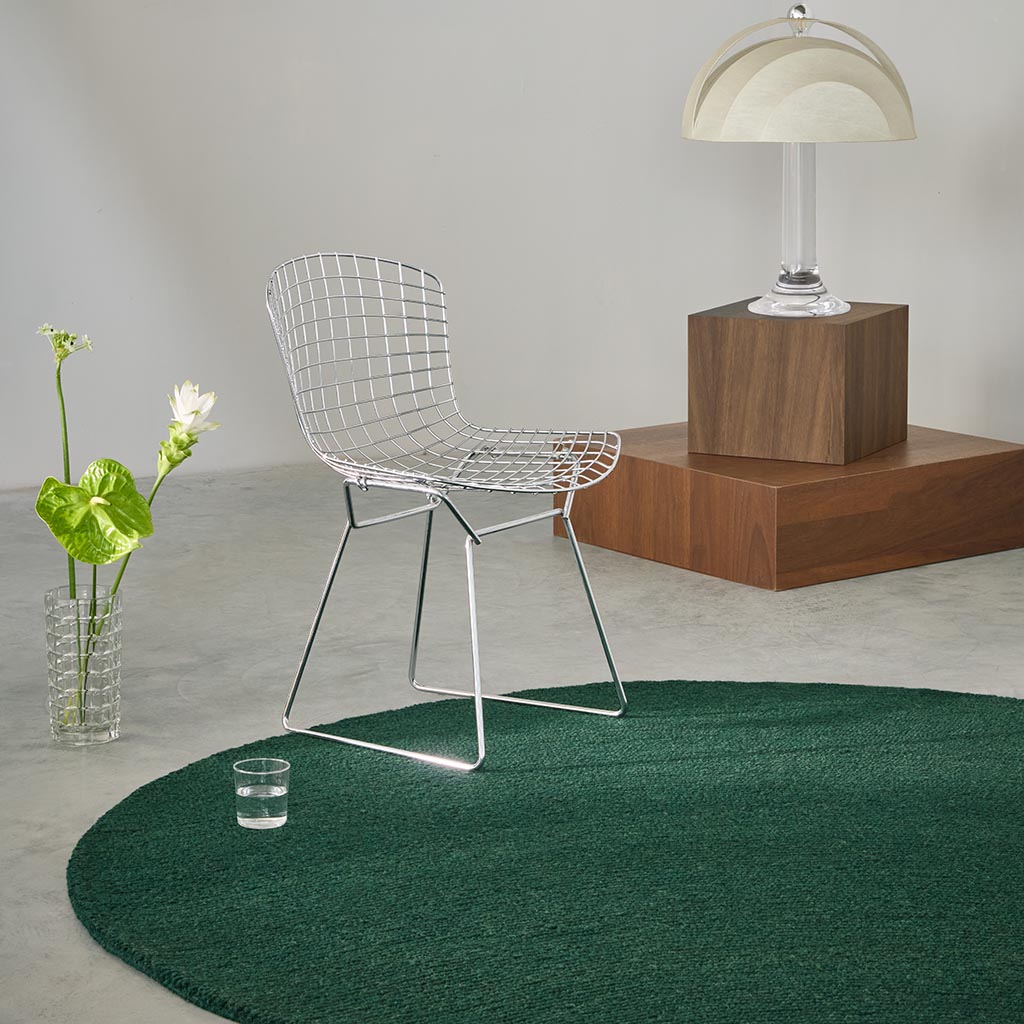
This is the one measurement worth committing to memory. The rug diameter should be the table diameter plus 120–140cm — that is 60–70cm of clearance all the way round — so that a chair pulled out for someone to sit down still has all four legs on the rug. A chair that tips off the edge mid-meal is both irritating and hard on the rug.
In practice that means a 120cm table, seating four, wants a rug of 240–260cm. A 140cm table wants 260–280cm. A 150cm table seating six wants around 270–290cm. Round rugs are commonly sold at 120, 150, 160, 200, 240 and 300cm, so you are usually rounding up to the next available size — and rounding up is always the right direction. If the maths pushes you past the width of the room, the honest answer is that the room is too small for a rug under that table.

Sizing Everywhere Else
In a seating area, treat the round rug as you would a rectangle: it should be wide enough that the front legs of the sofa and the armchairs sit on it, which usually means a minimum of 200cm and more often 240cm or 300cm. A 150cm circle floating between a sofa and a fireplace will always look undersized.
In a bay window or a corner, work outwards from the furniture instead. Allow 15–20cm of rug beyond the outermost chair leg in every direction and buy the nearest standard size above that figure. On a landing, keep the rug clear of the top step by at least 20cm — it must never overhang the nosing — and on any hard floor use an underlay, because a round rug has no long straight edge to hold it in position and will creep under foot traffic more readily than a rectangle.
The Common Mistakes
Buying too small is the first and by far the most frequent. A round rug has less surface area than a rectangle of the same nominal dimension, so a 160cm circle reads much smaller in a room than a 160 x 230cm rectangle does. Compensate by going up a size, not down.
The second mistake is putting a round rug into a room that is already full of curves. A curved sofa, an arched alcove, a round mirror and a round coffee table do not need a round rug as well — at that point nothing in the room is holding a line. Round rugs work hardest in rooms with strong rectilinear architecture, where the circle is the exception rather than the rule.
The third is centring on the wrong thing. A round rug wants to be centred on an object — a table, a pendant light, a chair — not on the room. Placed at the geometric middle of a floor with no anchor above or on it, it simply looks lost.
The fourth is forgetting the door swing. Circles have no straight edge to align to a threshold, so measure the arc of any inward-opening door before you commit to a diameter.
If the room resists a circle but you still want to escape the standard rectangle, square rugs are the quieter alternative — they suit square seating arrangements and square dining tables, and they solve the same proportional problem with less drama. For dining rooms specifically, it is worth looking at the whole dining room selection before deciding on a shape, and for a nursery or playroom the children’s room range covers the sizes that actually get used.
Round Rugs at Kelaty
Kelaty carries round rugs across wool, natural fibre and easy-care synthetic constructions, in diameters from small accent sizes up to full dining proportions. Browse the round rug collection.