Home Office Rugs: Comfort, Acoustics and Chair Wheels
The home office is the room most people furnished in a hurry and never went back to. A desk against a wall, a chair that was bought in a rush, a hard floor and largely bare walls — functional, unfinished, and slightly unpleasant to sit in for eight hours.
A rug is the single cheapest change that improves it, and it does three quite different jobs at once. It also introduces one problem that no other room has, which is a chair on castors. Get the pile height and the size right and everything else follows.
Three Jobs a Rug Does in a Home Office
Quietening the Room
A room with a hard floor, bare walls and a large flat desk is acoustically live. Sound bounces between parallel hard surfaces, and the result is the slightly hollow, echoing quality that everybody on the other end of a video call can hear and nobody in the room notices.
Soft flooring is the cheapest and least visible way to fix it. A rug absorbs mid and high frequencies, breaks up the reflection between floor and ceiling, and takes the ring out of a room immediately. The more floor you cover the more effect you get, and a denser, slightly deeper pile absorbs more than a thin flatweave. It also stops chair movement and footfall carrying through the floor to the room below, which matters if the office sits above a sitting room.
Warmth Underfoot
Sitting still for long stretches means feet get cold, and a hard floor draws heat away steadily. Wool is a genuinely good insulator and holds a comfortable temperature under the desk without any of the fuss of a heater. It is a small thing that changes how long you are willing to stay in the room.
Marking Out the Working Zone
Most home offices double as something else — a spare bedroom, a guest room, the end of a landing, a corner of a living room. A rug is the clearest way to say where the work happens and where it stops, and it lets you shut the desk out of view mentally at the end of the day.
Align the rug with the desk rather than with the walls. It is the working zone you are drawing, not the room.
The Chair Problem
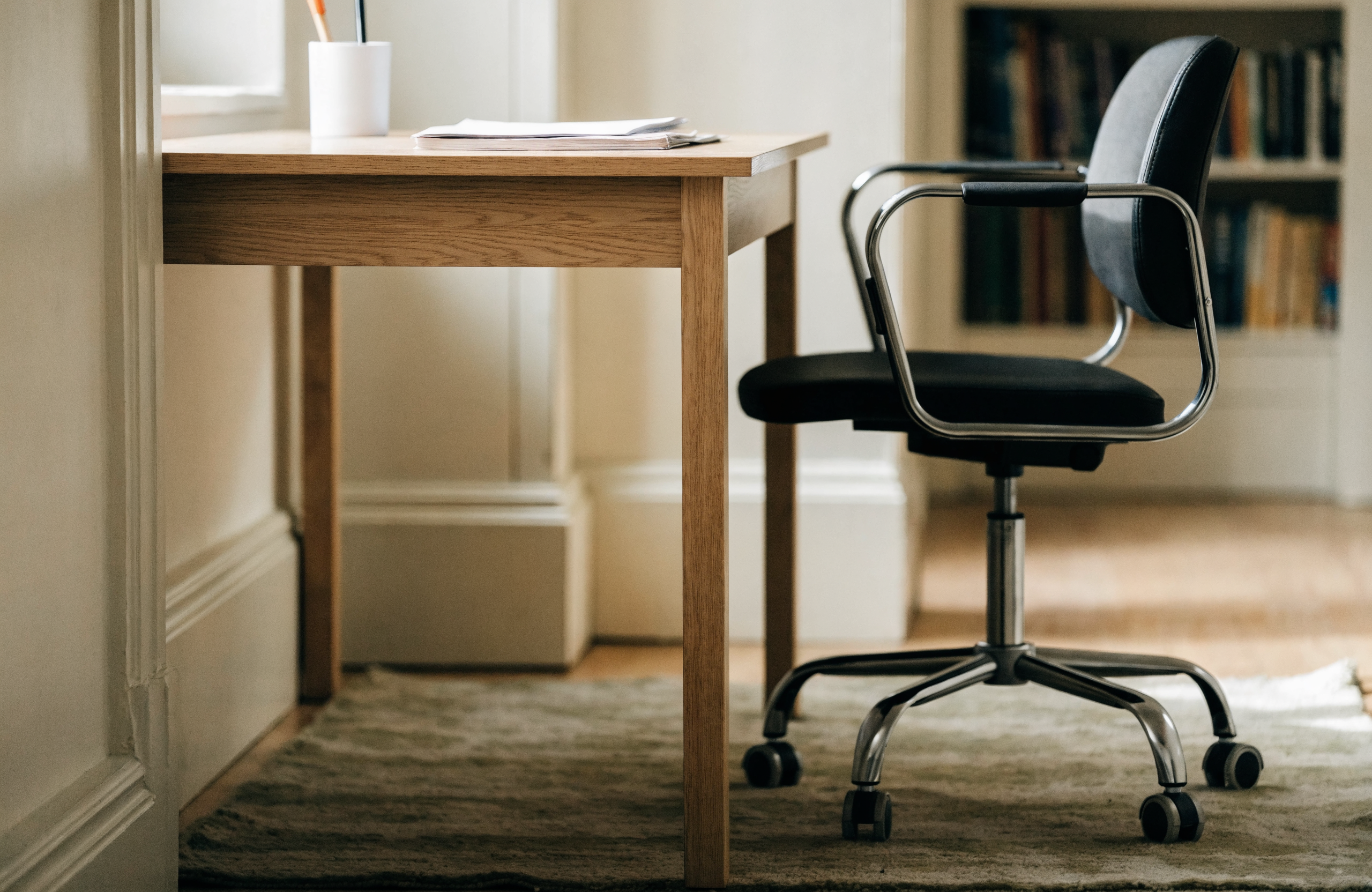
Castors are the reason most home office rugs fail, and they fail in two opposite ways.
On a deep or shaggy pile, wheels sink in, drag rather than roll, and twist as you turn — which pulls and eventually tears tufts out of the surface. Hard plastic castors, which are designed for carpet, cut into long fibres. Within a year there is a visible worn arc around the desk.
On a lightweight flatweave, the opposite happens: the chair pushes the rug ahead of it, the rug rucks into a ridge, and the corners lift. Fringes are worse again, since a castor will catch and pull them.
The answer is a low, dense pile — roughly 10mm or under, tightly constructed, with no fringe. That rolls well, resists crushing and does not fight the chair. A flatweave can work provided it is heavy and sits on a proper underlay so it cannot travel.
If you already own a rug you love that is too deep for a chair, a clear polycarbonate chair mat over the top solves it entirely. It is not a beautiful object, but it protects the rug completely and confines the compromise to a square metre or two.

Getting the Size Right
The rule for a home office is simple: the chair must stay on the rug through its entire range of movement. If a castor drops off the edge every time you push back from the desk, the rug will curl at that edge, the chair will jolt, and you will end up hating both.
In practice that means allowing roughly 120cm of rug behind the desk edge, plus the footprint of the desk itself. For a typical 140–160cm desk, that puts you in 200 x 290cm territory, with 160 x 230cm as a workable minimum for a small room and a compact desk.
Put the desk legs on the rug too, rather than leaving the desk on the floor and the rug floating behind it. A rug edge that crosses the wheel path is the thing that trips castors and lifts corners. A medium rug of 151–230cm covers most box-room offices; a full study or a shared room usually needs to go larger.
Colour and Pattern for a Room You Sit in All Day
A rug in a hallway is seen for four seconds at a time. A rug in a home office sits in your peripheral vision for eight hours, and that changes the advice considerably.
Avoid high-contrast, busy geometric patterns in your direct field of view — the effect that is striking in a dining room becomes visually noisy when you are trying to concentrate. Favour low-contrast, tonal designs where the interest comes from texture rather than from pattern: a subtle abstract, a soft heather mix, a plain with a visible weave.
Mid-tones are the practical choice as well as the restful one. They hide dust, paper scraps and the marks of a chair better than either extreme, and they keep a small room feeling calm. Save the statement piece for a room you walk through rather than one you work in.
A Few Practicalities
Wear will concentrate in the chair well, so rotate the rug 180 degrees twice a year to even it out. Use an underlay on any hard floor — it stops the rug travelling, adds a little more acoustic absorption, and protects the backing from grit.
One safety point worth stating plainly: do not run extension leads or cables under a rug. Coiled cable under an insulating layer builds heat, and a castor rolling repeatedly over the same spot damages the outer sheath. Route cables around the edge of the room or clip them under the desk instead.
If the room doubles as a guest room, choose the rug for the bed layout as well as the desk — see our thoughts on bedroom rugs for how those two sets of requirements can be reconciled.
Home Office Rugs at Kelaty
There is no dedicated office collection, because what an office needs is a low, dense, quietly patterned rug — which is exactly what a good contemporary design already is. Our modern rugs are the natural place to start.