Kitchen Rugs: What Actually Works
The kitchen is the hardest room in a house for a rug, and it is not close. Nowhere else combines airborne grease, dropped food, standing water, spills that stain permanently, chairs dragged back and forth, and more foot traffic than any room except the hallway — all of it on a hard, unforgiving floor.
Which is precisely why a rug earns its place there. Kitchen floors are cold, hard on the feet and acoustically brutal, and standing at a sink or a hob on tile for an hour is genuinely tiring. The trick is to choose something that treats the kitchen as the working room it is, rather than something precious that will be ruined by Christmas.
What the Kitchen Does to a Rug
Cooking releases a fine aerosol of grease that settles on every surface in the room, rug included. At first it is invisible: the pile becomes very slightly tacky, dust sticks to it, and over a year the rug develops a dull, grey cast that vacuuming does not shift.
Then there is water. The area in front of a sink or a dishwasher sees drips, splashes and the occasional small flood, and a rug that absorbs and holds water there will smell within weeks. And there is the food itself — tomato, turmeric, red wine, beetroot, olive oil and coffee are all things that stain fibres permanently if they are not dealt with quickly.
The design brief writes itself: whatever goes down needs to be washable, low, non-absorbent and forgiving of marks.
What Works
Flatweaves and Kilims
A flatweave has no pile for crumbs to bury themselves in, so debris sits on the surface and shakes straight out. It is thin enough not to be a trip hazard at a threshold, light enough to take outside and beat, and in most cases reversible, which doubles its life. Wool flatweaves handle grease better than you would expect, since the natural lanolin in the fibre resists it, and a good pattern hides a great deal.
Machine-Washable Rugs
This is the honest best answer for most kitchens. A rug that goes into a domestic washing machine at 30 degrees turns every spill from a crisis into a Tuesday. Check the drum capacity before buying — a 7–8kg machine handles a small rug or a runner comfortably, while anything larger needs a launderette. Look for a flat, thin construction that will actually dry in reasonable time.
Polypropylene
Solution-dyed polypropylene is non-absorbent, does not stain readily, tolerates strong cleaning, and dries quickly. It is the workhorse fibre for wet, messy rooms, and it is affordable enough that replacing it after a few years is not painful.
Low Pile and Mid-Tone Pattern
Whatever the fibre, keep the pile short and the colour in the middle of the range. A busy mid-tone pattern hides marks between washes better than anything else; pale cream shows every splash, and a very dark solid colour shows crumbs, flour and pet hair just as clearly.

What Does Not Work
Deep pile and shaggy rugs collect crumbs and grease in equal measure and cannot be cleaned properly at home. Viscose is the worst possible choice: it water-marks permanently, the fibres swell and lose their sheen when wet, and a single splash from the sink leaves a visible ring. Silk and hand-knotted pieces belong in a room where nobody is holding a saucepan.
Natural fibres deserve a specific warning. Jute, sisal and seagrass are lovely in a sitting room and a genuine mistake next to a sink — they absorb water, stain from it, discolour as they dry, and cannot be washed. Leather and hides have the same problem.
And nothing sentimental. If you would be upset to lose it, it should not be in the kitchen.
Where to Put It
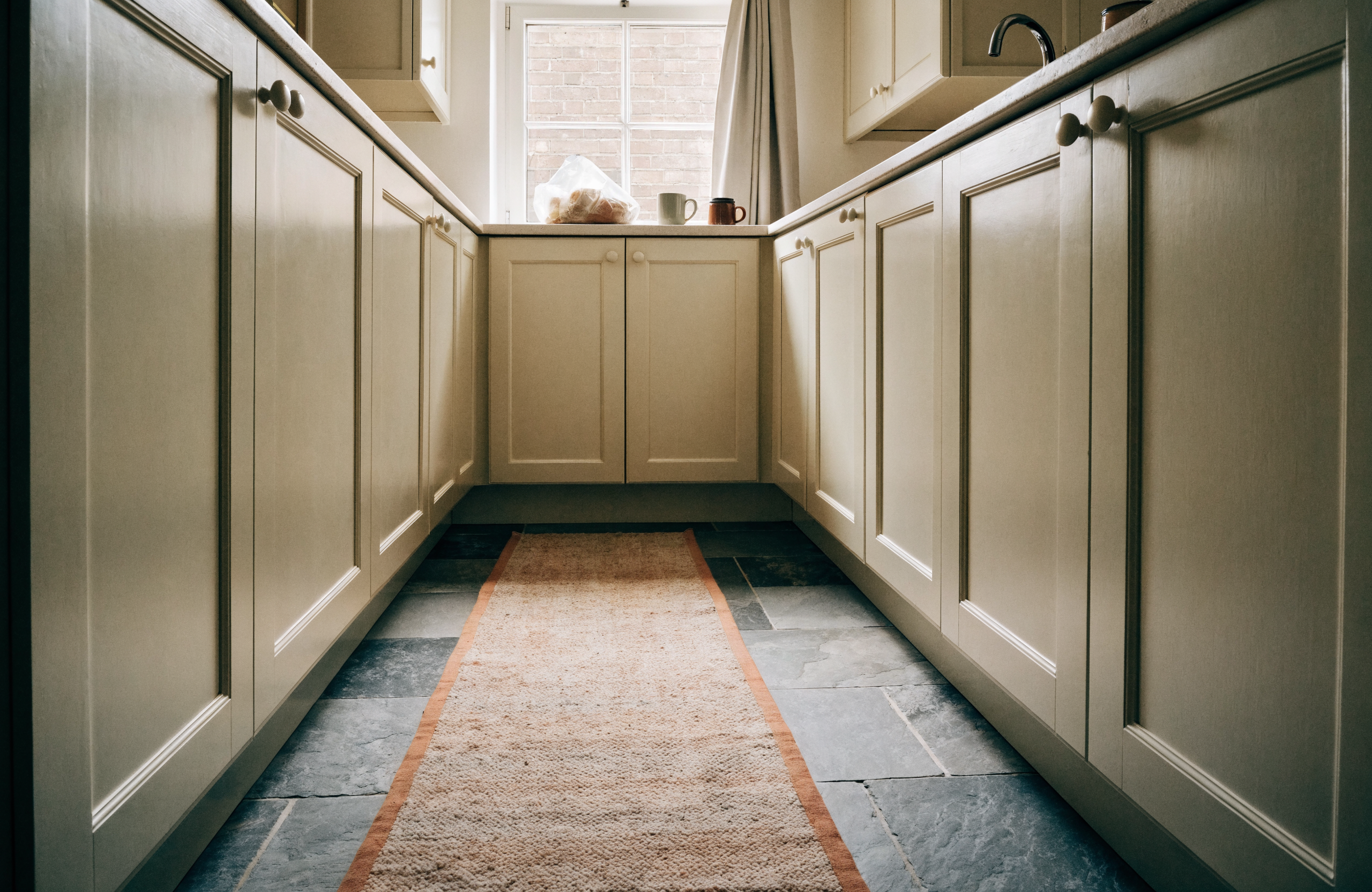
Placement in a kitchen is dictated by the units, not by the shape of the room. In a galley kitchen, a runner down the centre of the walkway is the natural answer — leave 10–15cm of floor showing on each side so the space does not feel narrower than it is.
In front of a sink, you want something that covers the whole standing zone rather than a small mat that skates about. Along an island, run the rug down the working length of the island and align it with the units rather than centring it in the room.
Two practical exclusions: keep the rug well clear of the oven door swing, so it is not underfoot when a hot door is down and not sitting where fat drips, and keep it clear of the dishwasher door, which will otherwise catch and ruck the edge every time it opens.
Sizing to the Run of Units
Measure the run of units the rug will serve and take 20–30cm off that as your target length, so it stops short of the ends rather than running past them. Standard runner widths of 60cm, 70cm and 80cm cover most UK kitchens; a wider galley or a generous island can take more. Runner formats suit kitchens better than any other shape, and for a sink or a doorway zone a small rug up to 150cm is usually all that is required.
Always leave the swing of every door — room door, oven, dishwasher, larder — completely clear.
Non-Slip Underlay Is Not Optional
On tile, vinyl, LVT or sealed wood, a rug without an underlay slides, and a kitchen floor is regularly wet. This is a safety issue, not a comfort one.
Use a thin rubber-mesh or felt-and-rubber underlay, cut 2–3cm smaller than the rug on every side so it does not show. On vinyl and LVT, check the underlay is compatible with the floor: some rubber backings react with vinyl over time and leave a mark or a discolouration that is difficult to remove. A reputable underlay will state what it is safe on.
Keeping It Clean
Shake it out weekly, blot spills immediately rather than rubbing them in, and wash it on a routine — monthly is a good default — rather than waiting until it looks like it needs it. Grease is far easier to remove before it has had months to set.
Kitchen Rugs at Kelaty
We do not have a kitchen collection as such, because the right kitchen rug is defined by how it cleans rather than by where it sits. Kelims and flatweaves are the traditional answer and still a very good one, and for anything that regularly gets wet, our Lux Washable range is the place to start.