Small Spaces: Choosing a Rug for Flats and Box Rooms
The most common mistake in a small room is buying a rug to match it. The logic feels sound: little room, little rug. In practice it produces the opposite of what you want, and it is worth understanding why before you measure anything.
A floor reads as generous when it reads as one continuous surface. A rug that is too small breaks that surface into pieces — a strip of floor here, an island of rug there, another strip of floor beyond — and the eye counts the pieces rather than taking in the whole. The room feels chopped up, and a chopped-up room feels smaller than it is.
Go One Size Larger Than Feels Right
The fix is counter-intuitive but reliable: in a small room, choose the larger of the two sizes you are deciding between, and let the furniture sit on it.
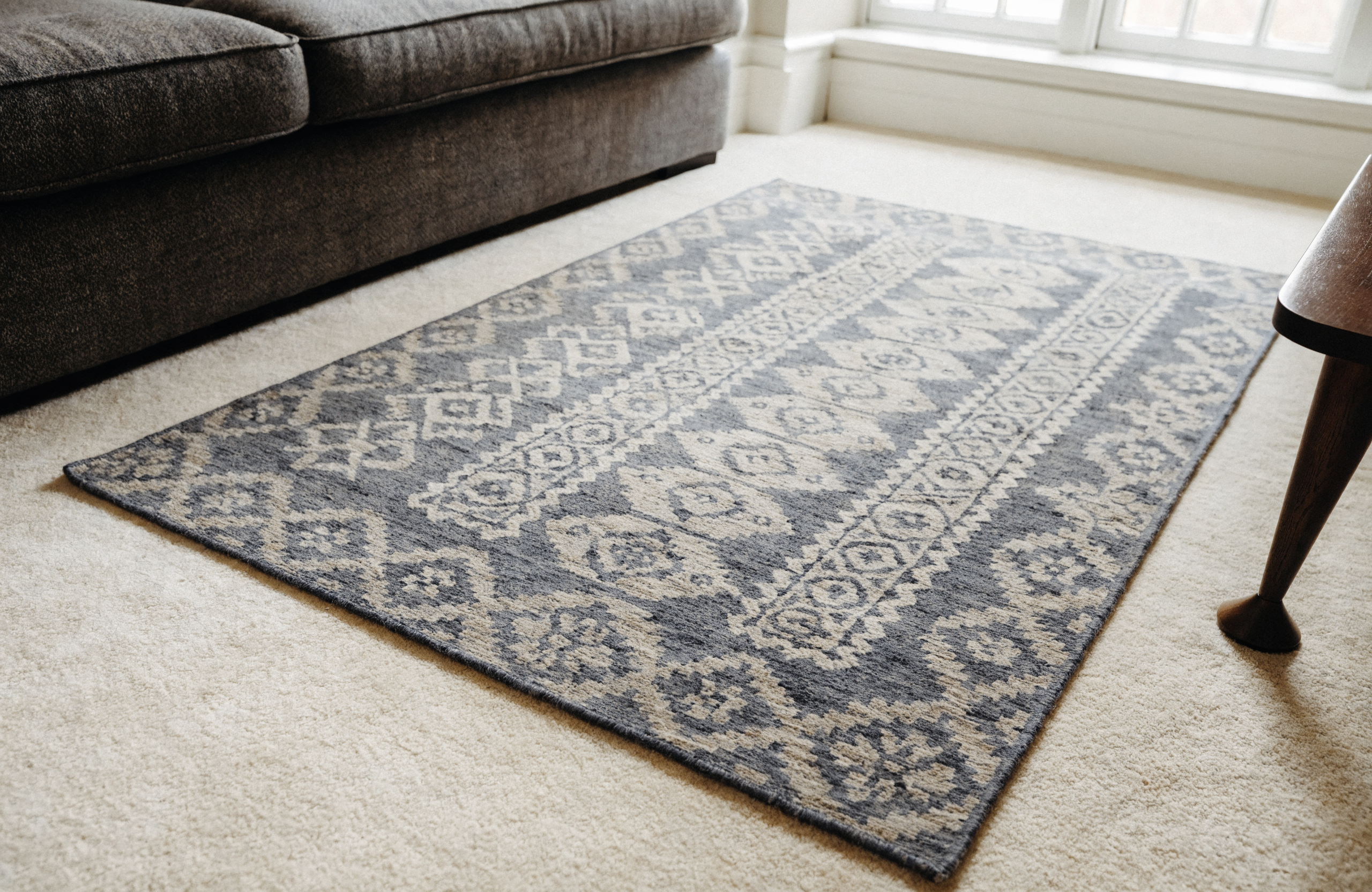
Getting at least the front legs of the sofa and chairs onto the rug does two things. It ties the pieces into a single arrangement rather than a set of objects scattered around the edges, and it pushes the visible floor out to a clean border at the perimeter. A consistent border of 20–30cm of bare floor around a rug that is otherwise doing all the work looks deliberate and calm. A rug floating in the middle with 80cm of floor on every side looks like it shrank in the wash.
There is a practical limit, of course. The rug should not run under the door swing, and it should not disappear entirely beneath the furniture — if you cannot see the design, you have gone too far. But most people stop one size short, not one size too far.
Box Bedrooms
The classic UK box room is a bedroom just wide enough for a double bed and a narrow walkway, and it defeats the usual advice about rugs surrounding a bed on three sides. There is simply no room.
Two arrangements work instead. The first is a single rug running down the accessible side of the bed, ideally wide enough that it is a surface rather than a mat — 80 x 150cm or 100 x 200cm, positioned so that it catches your feet when you get up rather than sitting decoratively out of reach. The second is a pair of runners, one on each side, which suits a room where both sides are walkable and gives a tidier symmetry than one rug and one gap.
The third option, if the bed sits against a wall with space at the end, is a rug placed across the foot of the bed with the bed's back legs standing on it. That anchors the bed into the room and gives a soft surface for dressing, without needing floor area that does not exist.

Small Living Rooms and Narrow Spaces
In a small sitting room, the rug should relate to the seating, not to the walls. Take the width of the sofa as your starting point: a rug narrower than the sofa always looks undersized. Extend it far enough forward to reach comfortably beyond the coffee table and under the front legs of any chairs, and let it stop short of the perimeter rather than trying to fill the room.
Narrow spaces — a galley kitchen, a slice of hallway, the walkway beside a kitchen island — call for a runner rather than a rectangle. A runner follows the direction of movement, which reinforces the length of the space instead of interrupting it. Leave 10–20cm of floor on either side, and choose a low pile so it sits flat and does not fight the doors.
Colour, Pattern and Scale
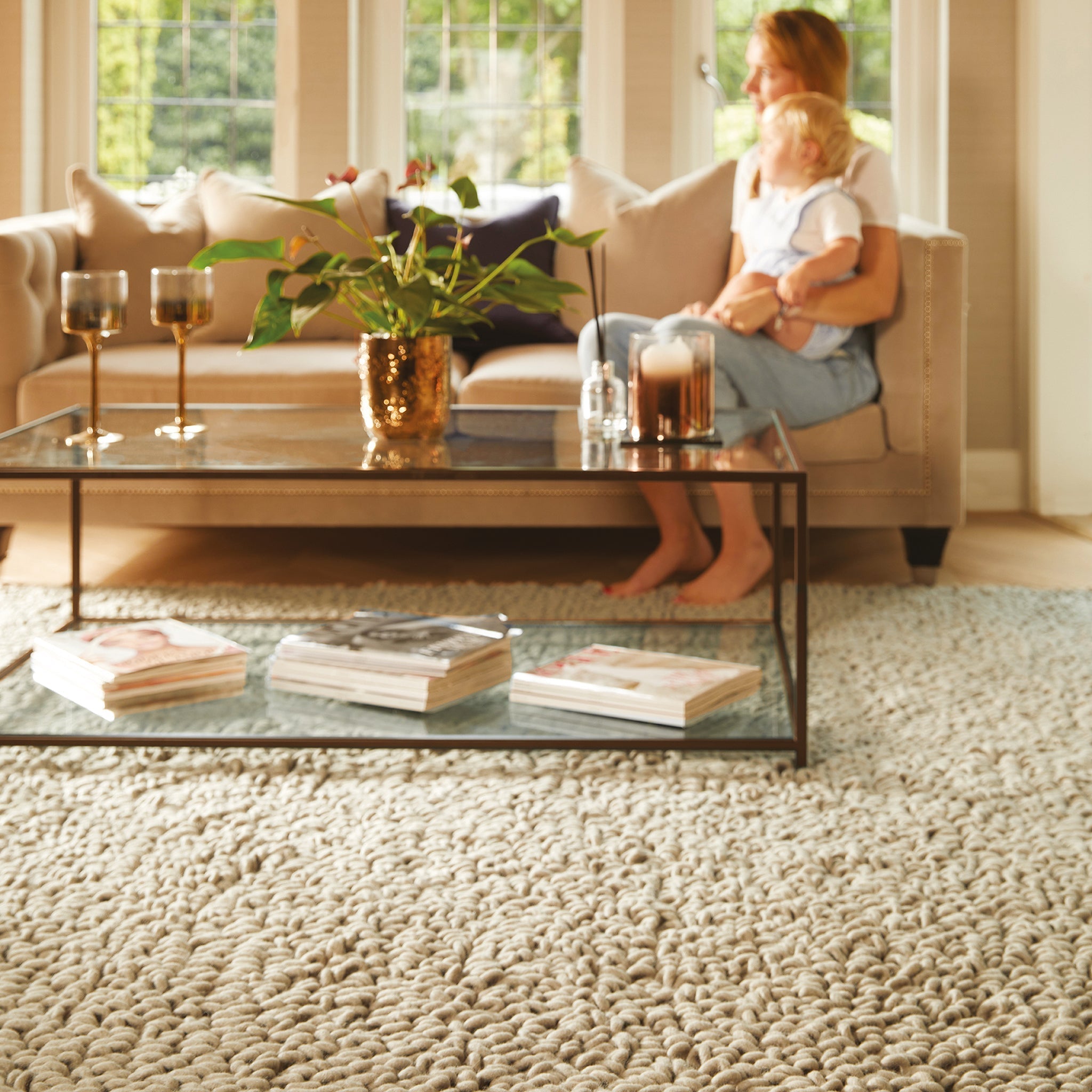
Light colours genuinely do open a room, because they reflect what light there is instead of absorbing it — and small rooms are often short of light to begin with. Pale grey, oatmeal, soft sand, chalk and stone all work well, and if you are worried about marks, look for a subtle tonal pattern rather than a flat pale ground, which forgives a great deal more than plain cream does.
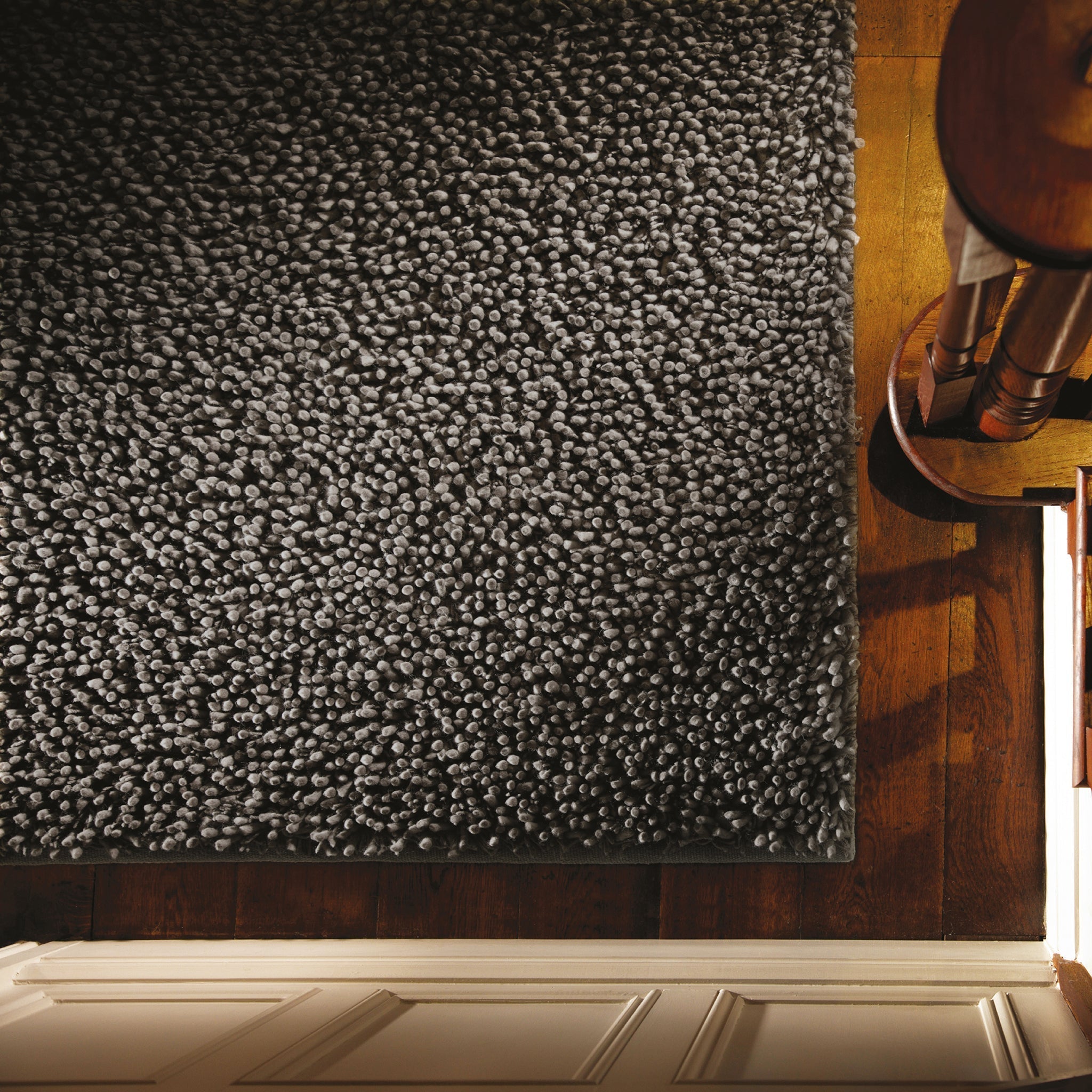
Contrast is the other lever. A high-contrast pattern of black on white is emphatic, and in a small space emphatic reads as busy. Low-contrast patterns — two tones of the same colour, a texture rather than a print, a design that resolves into a surface when you step back — add interest without adding visual noise.
The most useful rule about scale is the one people find hardest to believe: in a small room, one large motif works better than many small ones. A dozen small repeats subdivides the rug in the same way an undersized rug subdivides the floor, and the eye reads all those divisions as clutter. A single generous motif, or a wide simple stripe, gives the eye one thing to take in and lets the rug feel like a surface rather than a pattern sample.
Keeping the Floor Line Continuous
In a flat, the rooms are usually seen together — you look from the sofa through to the hall, or from the kitchen across the living space. Anything that draws a hard line at each threshold makes the flat feel like a series of small compartments.
Keeping the floor line continuous helps enormously. That does not mean identical rugs everywhere, but it does mean staying within one family of tones so the eye travels from room to room without a jolt, and avoiding a strongly different rug immediately on the other side of a doorway. If two rugs are visible at once, let one be plainer and let them share at least one colour. The effect is a flat that reads as a whole rather than as a set of rooms, and that is the single biggest thing you can do to make a small home feel larger.
Rugs for Small Rooms at Kelaty
Kelaty organises the range by size, which makes the comparison easy when you are deciding between two options. For most small living rooms, the size that works is one up from the one you first reach for — start with the medium range, 151–230cm.