Layering a Rug Over Fitted Carpet: Yes, You Can
Somewhere along the way, a rule took hold that rugs belong on hard floors and nowhere else. It is not a rule, and it never was. Putting a rug over fitted carpet is common practice in the homes of people who decorate for a living, and in a country where most bedrooms and a great many living rooms are carpeted, it is often the only way to get a rug into the room at all.
The reason it sometimes looks like a mistake is not the idea but the execution — a thin rug wandering across a deep carpet, in a tone so close to it that the whole thing reads as an accident. Handled properly, it looks entirely intentional. This is about a rug over carpet specifically, not the rug-on-rug layering covered elsewhere on this blog.
Why You Would Do It
There are four honest reasons, and most people have at least two of them.
The first is damage. A stain that will not lift, a burn near the hearth, a worn patch in front of the sofa or a section flattened by a piece of furniture that has since moved — all of these are expensive to put right and straightforward to cover. In a rented home, where replacing the carpet is not an option, a rug is the whole solution rather than a compromise.
The second is colour. Builder-grade and landlord-grade carpets are chosen for durability and neutrality, and the result is a lot of beige, oatmeal and grey. A rug is the fastest way to give a carpeted room a colour and a character it was not built with.
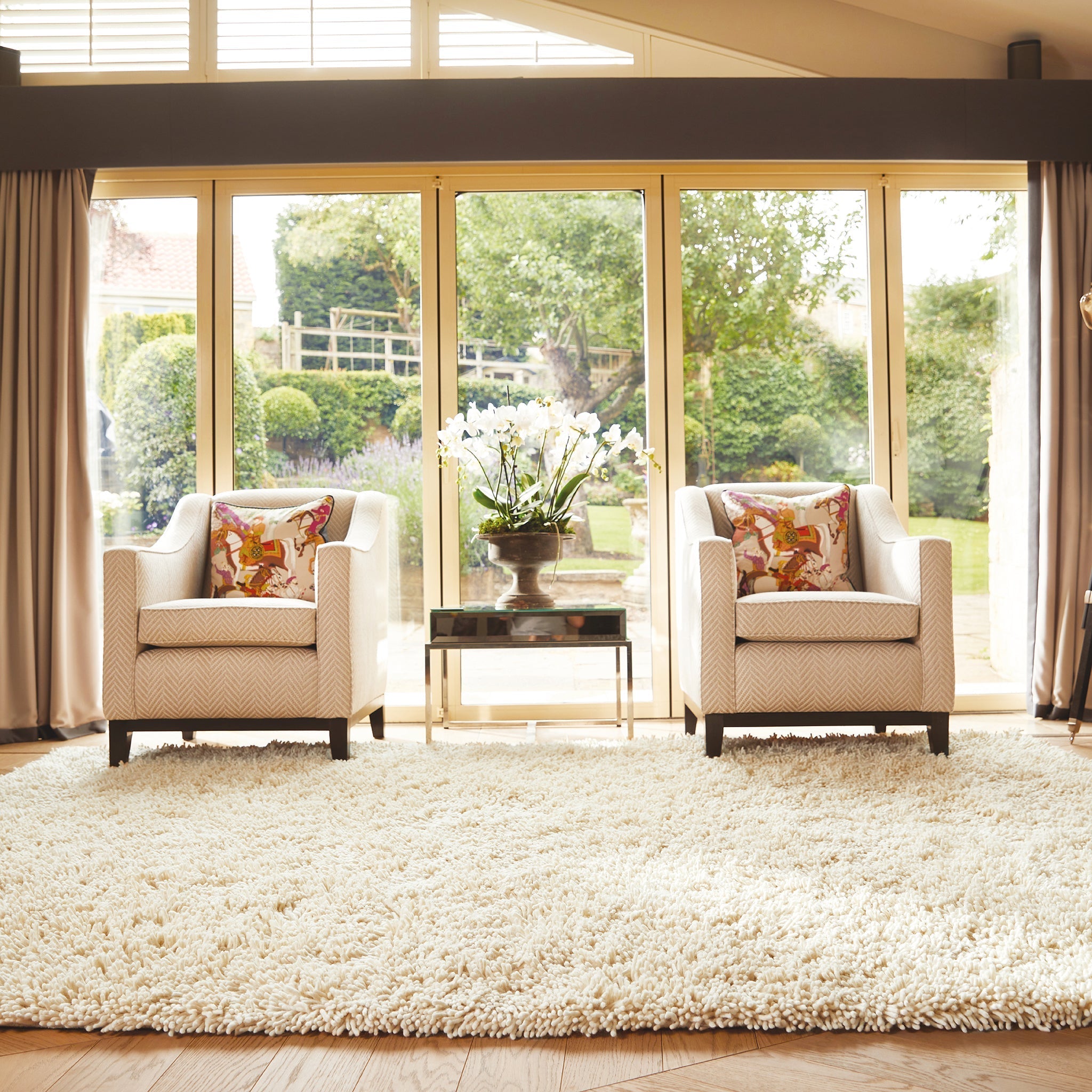
The third is zoning. In a large carpeted room, or a carpeted open-plan space, there is nothing for the furniture to gather around — the floor runs uninterrupted from wall to wall and the seating can end up looking marooned. A rug under the seating draws a boundary and gives the arrangement a centre.
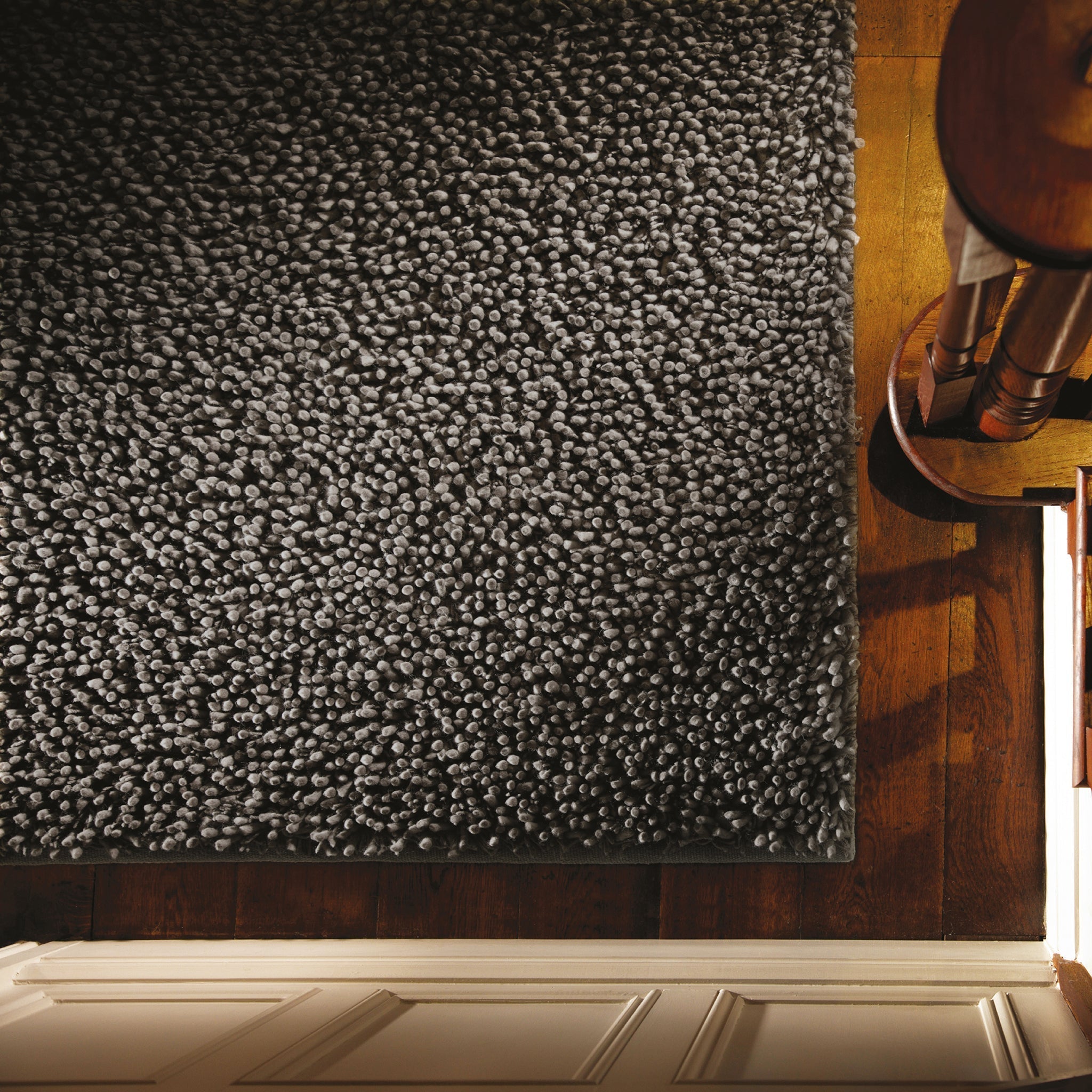
The fourth is texture. Fitted carpet is, by design, uniform. A hand-knotted pattern, a chunky flatweave, a wool loop or a natural fibre introduces something the carpet cannot: a change of surface, a visible weave, an edge.
Making It Look Deliberate
Whether this reads as a design decision or as something you did to hide a stain comes down to three things.
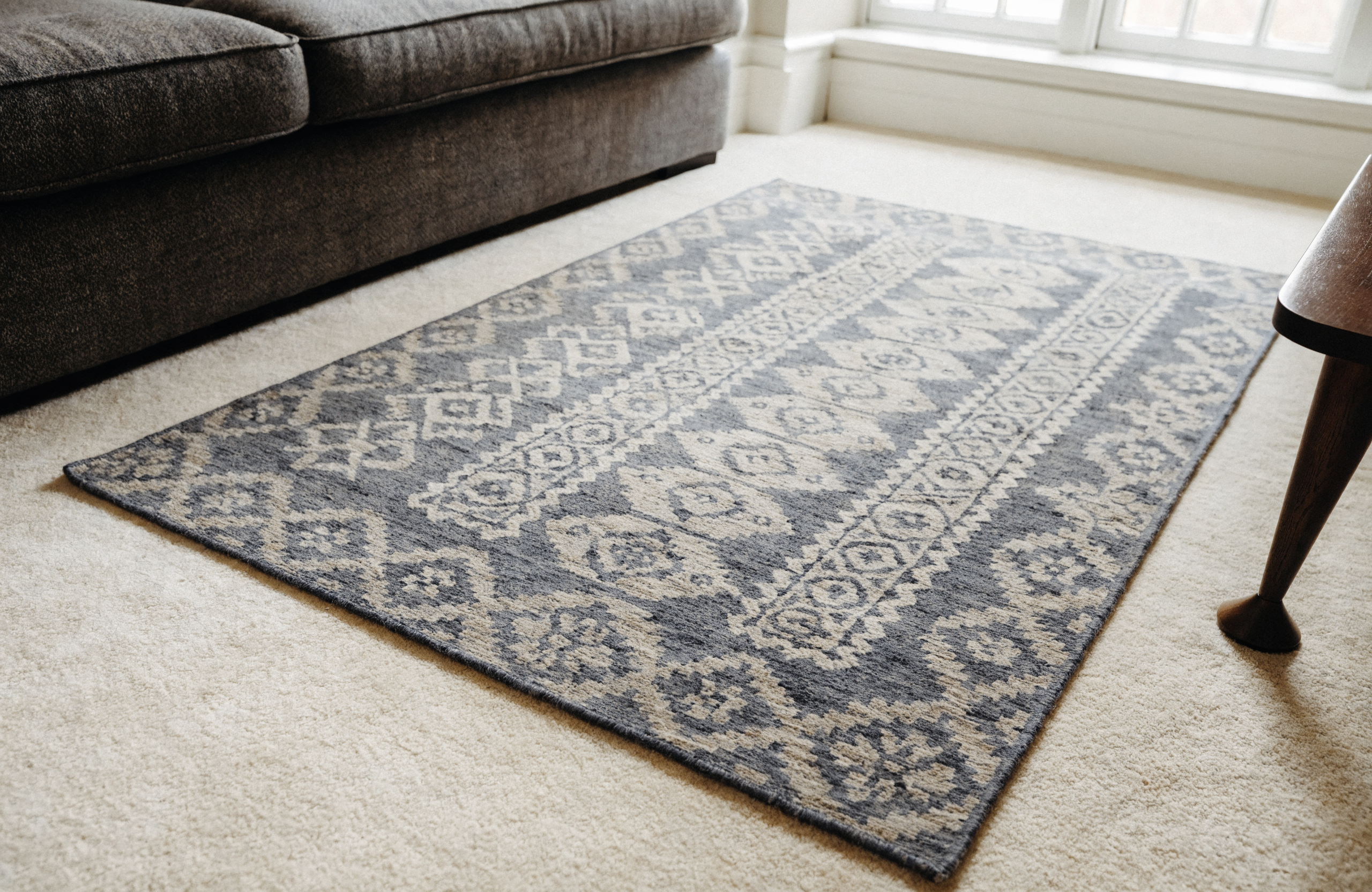
Contrast, in both texture and tone. This is the big one. The rug needs to be clearly different from the carpet underneath — different enough that no one wonders whether it was meant to match. A flatweave or a defined pattern over a plain cut-pile carpet works; a plain beige rug over a plain beige carpet looks like an offcut. If you want to stay within a neutral palette, get the contrast from texture and from a definite shift in depth of tone, not from a slight difference in shade.
A generous border of carpet. The rug should be obviously smaller than the room, with a clear margin of carpet showing all the way round — think 40cm or more at the narrowest point. Half-covering a room looks indecisive. Being clearly an island within it looks intended.
Square to the room. Lay the rug parallel to the walls and the furniture. An angled rug on a hard floor can look relaxed; an angled rug on fitted carpet almost always looks as though it has been kicked out of position, because there are no floorboards or tile joints to give the eye an alternative line.

The Practical Problem: Slipping and Rippling
A rug on carpet does not slide in the way a rug on laminate slides — it creeps. Under foot traffic the rug gradually walks itself out of position, the corners lift and, worse, the middle develops ripples and bubbles that never quite settle. Those ripples are a genuine trip hazard, and they wear the rug unevenly where it flexes.
Three things fix it.
- Use a carpet-specific underlay. The felt or rubber pads sold for hard floors do very little here. What you want is an underlay designed for use over carpet, gripping on both faces — one side to hold the rug, the other to key into the carpet pile.
- Choose a heavier rug. Weight does much of the work on its own. A dense flatweave or kelim stays put far better than a light machine-made piece, and hangs flatter at the edges. If you are choosing between two rugs you like equally, take the heavier one.
- Avoid deep pile over deep pile. A shaggy rug on a deep-pile carpet has nothing solid to sit against. It moves, it ripples, and the two piles merge at the border so the rug loses its edge entirely. Over a deep carpet, go low-pile or flatweave.
Trim the underlay 2–3cm smaller than the rug on every side so it never shows, and check the rug's position every few weeks — small corrections stop a creep becoming a permanent distortion.
One Warning: Dye Transfer
The one way this can go genuinely wrong is dye transfer. A rug that is damp — from a spill, from cleaning, from being brought in out of the rain, or from a radiator leak — can release colour into a pale carpet underneath, and the resulting stain will be exactly the shape and size of the rug.
Test any new rug before it goes down over light carpet: press a damp white cloth firmly into the pile for a few seconds and see whether any colour comes away. If it does, that rug belongs on a hard floor. And whenever a rug over carpet does get wet, lift it, dry both the rug and the carpet properly, and only put it back when both are completely dry.
Rugs Over Carpet at Kelaty
For layering over fitted carpet, look for weight and a defined surface — flatweaves and hand-knotted constructions are the safest bet. Browse the living room range for something to anchor a carpeted sitting room.