How to Flatten a New Rug and Fix Curling Corners
A rug arrives, the wrapping comes off, and it refuses to behave. Ripples run across the width, one corner lifts stubbornly off the floor, and there is a crease down the middle that looks like it will be there forever. It is a deflating moment after weeks of choosing, and it is also completely normal.
Almost every rug that is not laid flat in a warehouse arrives with some memory of how it travelled. The fibres and the backing have been held in one shape for days or weeks, and they need time and a little help to forget it.
Why a New Rug Does Not Lie Flat
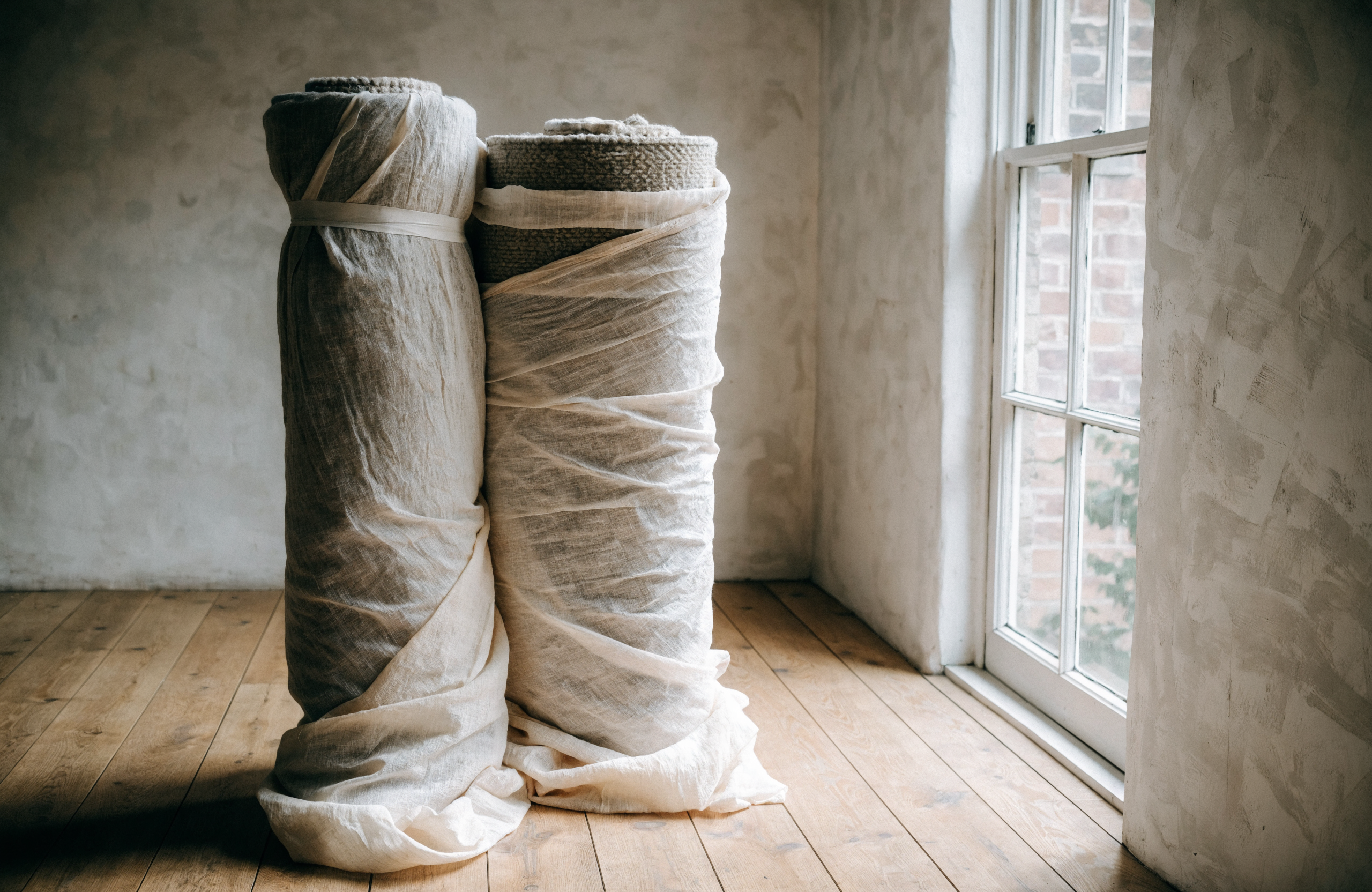
Three things are usually at work. The first is the memory of the roll itself — the pile and the foundation have been curved in one direction under tension, and the tighter and longer the roll, the more they hold that curve.
The second is folding. Larger rugs are sometimes folded once or twice to fit courier size limits, which puts a hard crease across the width rather than a gentle curve. Those take longer to release than a rolled crease.
The third is backing tension: many tufted and machine-woven rugs have a latex or cotton backing that relaxes at a different rate from the face fibres. Add a rug that has spent two days in a cold van and you have a stiff, unwilling object that will be a different animal after a day in a heated room.
Start by Doing Nothing
Unroll the rug face up, in the room where it will live, and leave it alone for 24–48 hours. Do not judge it, do not stand furniture on it yet, and resist the urge to intervene. Warmth and gravity do most of the work on their own, and a surprising number of rugs are flat by the second morning.
If the room is cold, warm it — a rug at 18–20 degrees is far more pliable than one at 8. Give it a week before deciding you have a problem.
Reverse-Rolling
If ripples remain after a couple of days, roll the rug back on itself the opposite way — pile side out, which is the reverse of how it was shipped. Keep the roll loose and even rather than tight, secure it lightly, and leave it for an hour or two.
Unroll it, lay it flat and see where you are. Two or three gentle repeats do more than one aggressive attempt. Never force a rug into a tighter curve than it went in, and never reverse-roll a hand-knotted piece with a brittle foundation.
Warmth, Applied Carefully
Sunlight through a window for an hour or two on a warm day relaxes fibres nicely. Keep it brief — prolonged direct sun fades dyes, and a rug left in a sunny patch for a fortnight will show it. Underfloor heating has the same softening effect over a day or two.
Using an Iron — Wool Only
As a last resort on a stubborn fold, a wool rug can be pressed from the back. Turn it face down onto a clean, flat surface, lay a damp cotton cloth over the backing, and use a warm iron with the steam off, keeping it moving constantly. Never press and hold, never iron the pile side, and never let the iron touch the rug directly.
Do not do this to a viscose rug or a polypropylene one under any circumstances. Both are heat-sensitive, and direct heat melts and glazes the fibres into a shiny, hard, permanently flattened patch. There is no repair for it.

Weighting the Corners
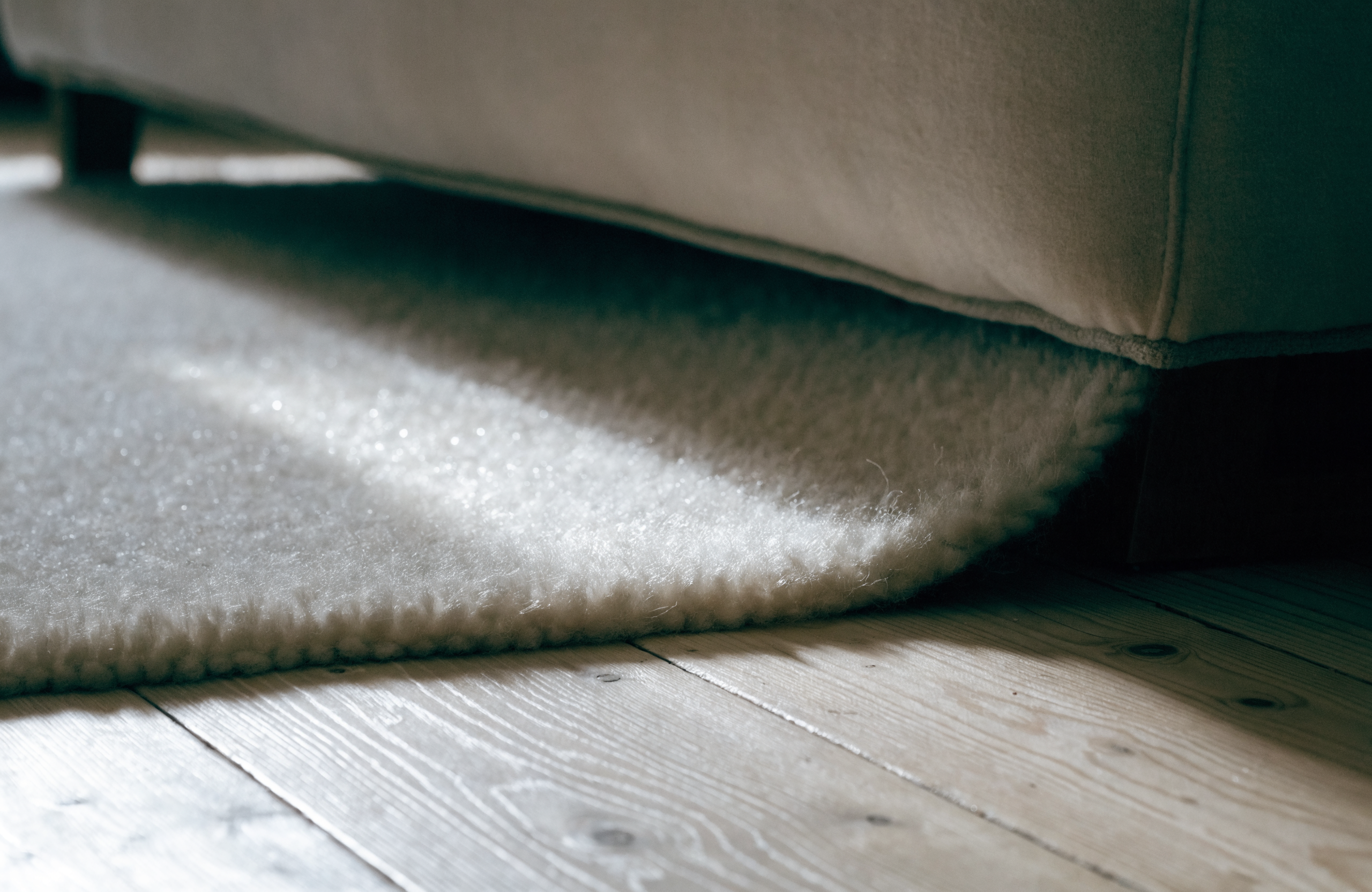
For lifting corners and edges, weight is the simplest fix. Stack books or place a piece of furniture, spreading the load over as wide an area as you can rather than one point.
Put a cloth between the weight and the pile — book covers and some furniture feet can transfer dye or mark pale wool. Leave it for several days rather than overnight; corners are the slowest part of a rug to give in.
Curling Corners That Keep Coming Back
If a corner lifts again the moment the weight comes off, no amount of pressing will hold it. The real fix is an underlay.
A good underlay grips the whole rug against the floor, adds body to a thin construction, and stops a corner being flicked up by a passing foot. Cut it 2–3cm smaller than the rug on all sides so it never shows, and choose one suited to your floor — a felt and rubber pad for hard floors, a thinner grip mat under a rug on carpet.
Corner grippers — thin adhesive triangles fitted to the underside of each corner — are a lighter-touch alternative and work well on rugs that are otherwise flat. Double-sided carpet tape is the last option, and comes with a warning: on wood, vinyl and LVT it can leave residue or lift a finish when it comes up. Test it in a hidden spot first.
What Not to Do
Do not vacuum aggressively over a rug that is still creased or rippled. A rotating brush bar catches the raised edge of a fold, drags the weave out of square and can shred a fringe in seconds. Use suction only until the rug is lying flat.
Do not soak a crease in the hope of relaxing it — you will get a ring mark, particularly on viscose. Do not trim anything. And do not leave one heavy item on a single spot for weeks, which swaps a crease for a permanent dent.
When It Is Not Going to Settle
Give it a month. If a rug has lain flat in a heated room, been reverse-rolled, weighted and put on a proper underlay, and it still has a ripple that will not go or a corner that lifts hard, that is not a creasing problem — it usually means uneven tension in the backing or the weave, which is a manufacturing fault rather than a shipping one.
Photograph it in daylight from a low angle so the ripple is visible, and raise it with the retailer rather than continuing to fight it. A genuine tension fault does not improve with time.
Getting a Rug to Sit Right at Kelaty
Some constructions settle faster than others: a heavy kelim or flatweave needs an underlay to sit properly, while a deep pile hides minor unevenness almost immediately. If you would like a recommendation for your floor and construction, our team is happy to advise. Browse plains and shaggys.