Moths and Wool Rugs: How to Prevent, Spot and Treat Damage
Of all the things that can go wrong with a wool rug in a British home — spills, fading, a worn traffic lane across the middle — the one that does permanent, irreversible damage is also the quietest. Clothes moths give no warning. By the time most people notice, a patch of pile has already gone, and no amount of cleaning brings it back.
Wool is keratin, the same protein found in hair and horn, and a few insect larvae have evolved to digest it. A centrally heated house with warm, still, undisturbed corners suits them perfectly, and mild UK winters mean they are no longer a summer problem. The damage is also almost entirely preventable.
Which Moth Is Actually Eating Your Rug
Two species account for nearly all wool rug damage in the UK: the common clothes moth and the case-bearing clothes moth. Neither is the large moth that blunders around a lamp on a summer evening, which is harmless to textiles.
The single most useful fact about both is that the adult moth eats nothing at all — it has no mouthparts and lives a few weeks purely to breed. All the damage is done by the larvae that hatch from its eggs, so swatting the adult you see achieves very little. It is, though, a strong hint that larvae are at work nearby.
The Common Clothes Moth
Small, buff-gold, roughly 6–8mm long and notably reluctant to fly. It scuttles along skirtings and prefers dark places, which is why it is so often missed. Its larvae are cream-coloured grubs a few millimetres long that spin fine silky tunnels across the base of the pile as they feed.
The Case-Bearing Clothes Moth
Slightly darker, with faint spots on the wings. Its larva builds a portable case out of silk and fibres taken from whatever it is eating, and drags it around: a small object shaped like a grain of rice, in exactly the colour of your rug, and almost invisible until you know to look.
Where the Damage Happens
Not in the middle of the room. Larvae are driven away from light and movement, so they feed in the parts of the rug nobody sees, nobody walks on and nobody vacuums.
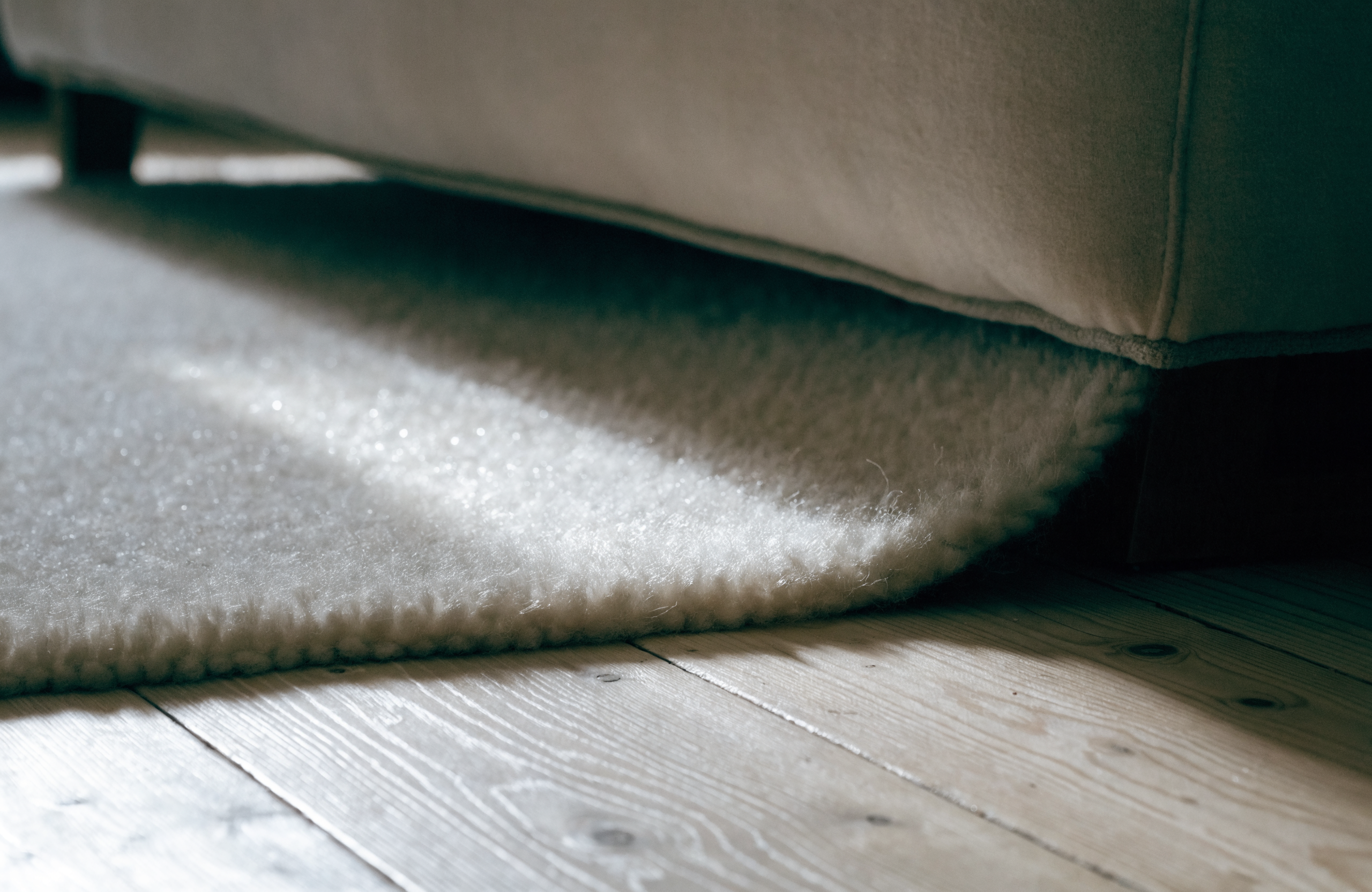
In practice that means under the sofa, under a bed, under a chest of drawers, along the strip that runs behind furniture against the skirting, and along a rug edge folded under to fit a space. Anywhere dark, still and permanently undisturbed is where you should look first.
How to Spot It Early
Lift a corner of the rug under the sofa two or three times a year and look at both the surface and the back.
Thinning pile is the clearest sign: a patch that sits lower than the rest, looks slightly bald, and where the foundation shows through when you part the fibres. Fine, sand-like frass is the next — gritty debris the exact colour of the rug, because it is the rug. Silky webbing tubes indicate the common clothes moth; small fibre-covered cases indicate the case-bearing kind.
None of this appears overnight, which is why regular inspection matters more than reacting quickly.

Prevention Is Mostly Housekeeping
Vacuum under and behind furniture, not just around it. This is the single most effective measure there is, and once a month is plenty.
Move furniture periodically. Shifting a sofa 30cm every few months exposes the strip beneath it to light and air and makes it a far less attractive nursery. Turn the rug end to end twice a year while you are at it.
Air the rug outside on a dry, breezy day and give it a firm shake. Larvae dislike light and disturbance, and airing removes much of the dust they live in. And never put a dirty rug into storage — food traces, body oils and pet hair make wool considerably more appetising. If a rug is going away for a season, it goes away clean.
Cedar, Lavender and What They Can and Cannot Do
Cedar blocks and lavender sachets have a real but limited effect. Their oils can deter an adult female from choosing a spot to lay in, which is worth something in a wardrobe or a wrapped, stored rug. They do nothing at all to larvae already feeding in the pile, and cedar loses its scent within months unless sanded back. Treat them as a mild deterrent alongside good housekeeping, never as a cure.
Treating a Rug That Is Already Infested
Act on the whole rug, not just the visible patch, and check any adjacent wool at the same time — another rug, a throw, a stored jumper in the same room.
For a small rug, freezing works. Vacuum it thoroughly, seal it in a bag, and put it in a domestic freezer for at least two weeks. The cold itself is less important than the duration; a short chill will not do it.
For anything too large to freeze, or for a hand-knotted piece, use a professional rug cleaner rather than a carpet-cleaning service. A proper wash flushes out eggs, larvae and frass together, and a specialist will tell you whether the damaged area is worth reweaving.
Pheromone traps are a monitoring tool, not a cure. They catch adult males and tell you whether a population is still active and roughly where. Put a couple down after treatment and check them monthly — an empty trap after three months is the best evidence that the problem is over.
Synthetics, Viscose and Blends
Polypropylene, polyester and nylon are not eaten, and neither is viscose, which is a plant cellulose fibre rather than a protein one. That does not make a synthetic rug immune: the dust, crumbs, pet hair and shed wool fibres that collect deep in any pile are perfectly good larval food, and larvae will live happily in a synthetic rug while feeding on the debris in it.
Watch blends in particular: a rug that is only 20 per cent wool is still 20 per cent food, and mixed-fibre rugs are the ones people forget to check. Machine-washable rugs have a real advantage here, since a wash deals with the debris and anything living in it in one go.
Wool Rugs at Kelaty
A well-made wool rug will outlast most of the furniture in the room, provided the parts nobody sees get looked at once in a while. Our Oriental and traditional ranges include hand-knotted wool pieces built to be repaired rather than replaced. See all ranges A–Z.