How to Store a Rug Without Ruining It
Rugs go into storage for all sorts of reasons — a heavy wool piece comes up for the summer, a house move needs the floors clear, a room is being decorated, or a rug simply does not suit the sofa that replaced the old one. It goes into the loft, and six months later it comes out with a crease that will not shift, a musty smell, or a bald patch nobody can explain.
More rugs are lost to bad storage than to daily use, largely because storage damage happens slowly and invisibly. The method below takes an afternoon and prevents almost all of it.
Clean It and Dry It First
This is the step people skip, and it is the one that matters most. A dirty rug going into storage is an invitation: food traces, drink residue, skin debris and pet hair all make wool considerably more attractive to moth larvae than clean wool, and a stored rug is exactly the dark, undisturbed environment they want.
Vacuum both sides thoroughly, including the back, and give the rug a shake or a beating outdoors if you can. If it needs more than that, have it professionally cleaned before it goes away rather than after it comes back.
Then make sure it is bone dry. Even slight residual moisture in a rolled, wrapped rug will cause mildew, can allow dyes to migrate from one part of the pile to another, and will rot a cotton foundation over a winter. After any wet cleaning, leave the rug flat in a warm, airy room for a couple of days before rolling — longer than you think it needs.
Roll It, Never Fold It
Folding is the fastest way to ruin a rug. A fold concentrates all the stress along a single line: the pile crushes permanently, the backing creases, and in older or hand-knotted pieces the foundation threads can crack along the fold and eventually split.
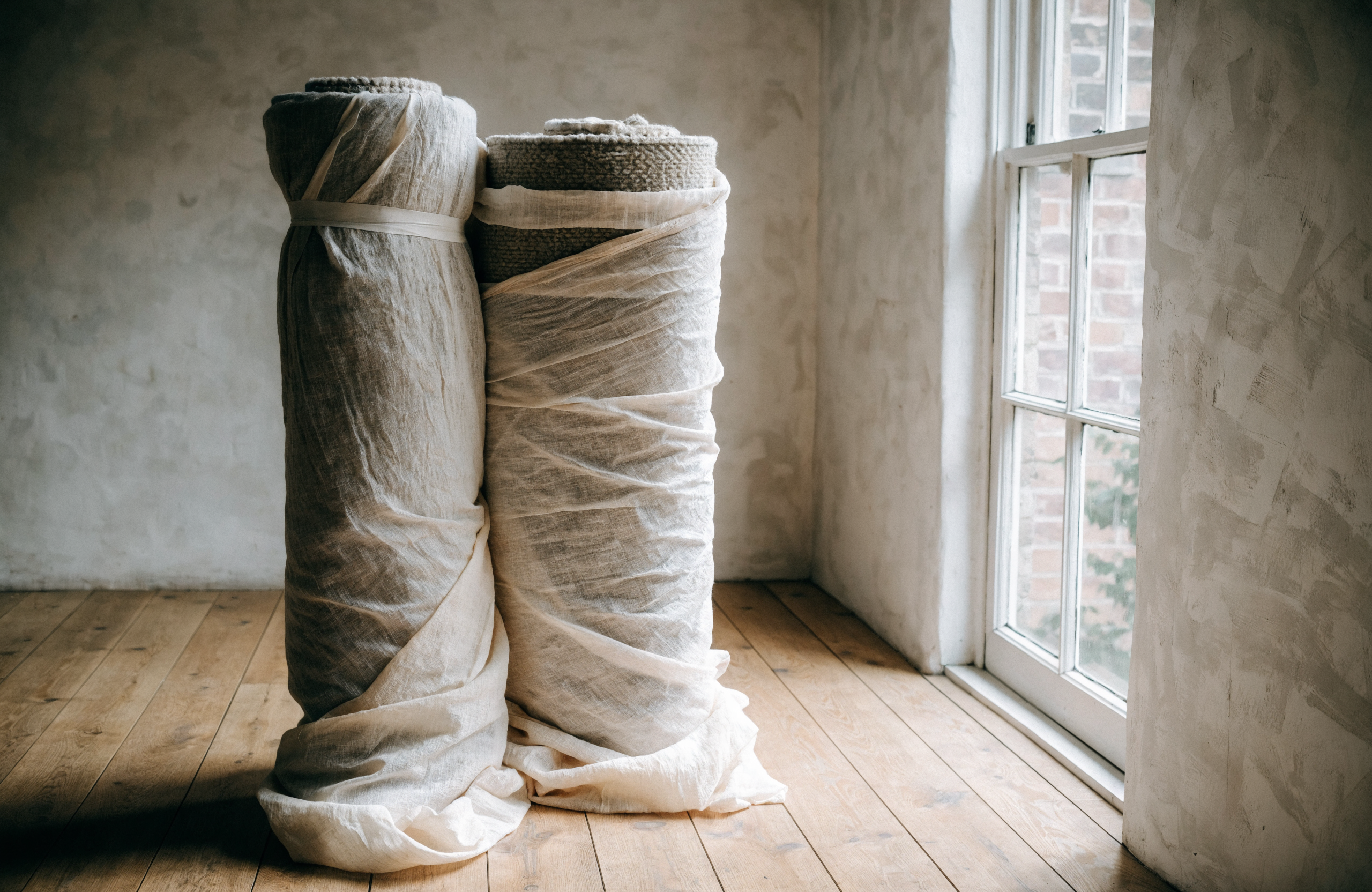
Roll instead, around a cardboard tube if you have one — a carpet or postal tube is ideal, and it stops the innermost part of the roll being wound too tightly on itself. Roll with the pile facing inwards. This puts the pile on the compressed inside of the curve where it is protected, and leaves the more robust backing on the outside where it takes the tension. Roll in the direction of the pile, keep the edges square as you go, and stop periodically to straighten rather than correcting at the end.
Secure the roll with cotton tape or strips of fabric, tied firmly but not tightly. Thin string or cord bites into the edges over months and leaves a permanent indentation.
Fringes and Edges
Comb fringes straight with your fingers before rolling and let them lie flat inside the roll. Never fold them back on themselves and never let them be crushed under the tie — a kinked fringe rarely recovers, and knotted or matted fringes are difficult to put right.

Wrap It in Something That Breathes
Cotton sheeting, unbleached calico or a breathable housewrap such as Tyvek are all good choices. An old cotton bedsheet works perfectly well.
Do not use plastic sheeting, bin bags or shrink wrap. Plastic traps whatever moisture is already in the rug, then adds more: as temperatures rise and fall the air inside condenses against the plastic and the rug sits in it. Mildew, musty odour and dye bleed all follow. Wool needs to exchange moisture with the air around it, and sealing it stops that.
Tape the wrapping to itself rather than to the rug, and seal the ends of the roll so nothing can get in. A cedar block or a lavender sachet tucked into the wrap is a reasonable extra deterrent, though it is no substitute for having cleaned the rug properly. Label the outside with the size and a note of which room it came from — a wrapped roll looks exactly like every other wrapped roll after a year.
Where to Put It
Store the roll flat and raised off the floor. A shelf, a couple of battens, a pallet or the top of a wardrobe all work. Anything resting directly on a concrete or garage floor will wick moisture upwards regardless of the wrapping.
Never stand a rug on end. All the weight of the roll settles onto the bottom edge, which crushes the pile there, distorts the shape of the rug and can break the foundation along that edge.
Never stack anything on top of it, and never lay another rolled rug across it. A flat, evenly supported roll with nothing on it keeps its shape indefinitely.
Choose somewhere cool, dry, dark and reasonably stable. A loft that bakes at 40 degrees in July and freezes in January is one of the worst places in the house, and a damp garage or cellar is worse still. In practice, under a spare bed or on top of a wardrobe in a normally heated room beats both by a wide margin.
Check It Every Few Months
Put a reminder in the diary for every two or three months. Unwrap the roll, unroll the rug, and look at the back and the edges for the fine gritty frass or silky webbing that indicates moth larvae. Give it a few hours of air and light while it is out.
When you re-roll, start from the opposite end so that the same fibres are not compressed in the same places for another season. The whole exercise takes twenty minutes and is the difference between finding a problem early and finding a hole.
Bringing It Back Out
Expect creases. Unroll the rug face up in a warm room, leave it for 24–48 hours before judging it, and weight any lifting corners with books rather than attacking them. Vacuum with suction only until it is lying properly flat, and put it back down on a suitable underlay — a rug that has been rolled for months needs a little help to grip.
Looking After a Rug for the Long Term at Kelaty
A rug that is cleaned, rolled and stored properly comes out of a decade in storage looking much as it went in, which is the whole argument for buying something well made in the first place. Hand-knotted wool pieces in our Oriental and traditional collection are built for exactly that kind of lifespan, and natural fibre constructions such as jute need the same breathable treatment. Browse all ranges A–Z.