Rugs by the Fireplace: Styling the Hearth for Wood-Burner Season
There is a particular moment each autumn when the first fire of the season is lit, and a sitting room suddenly finds its centre again. For many British homes the hearth is the natural heart of the room from October to March, and the rug laid in front of it does a great deal of work: it frames the fireplace, gathers the seating around it and gives bare feet somewhere warm to land. It also sits closer to heat, ash and the occasional spark than any other rug in the house, so it deserves a little more thought. Here is how we approach it.
Start with safety, then style
No rug, whatever it is made from, should be treated as fireproof, and the first rule is simply distance.
- Respect the hearth. Keep the rug clear of the hearthstone itself rather than running it up to the fire. The hearth is there to catch embers; the rug should begin where the hearth ends, with a comfortable margin.
- Follow your stove's guidance. Wood burners and multi-fuel stoves come with installation guidance on clearances to combustible materials. Check it, and if in doubt ask your installer before you choose a size.
- Use a guard with an open fire. A spark guard in front of an open grate protects the rug as well as the room, and is worth the small compromise in looks.
- Keep the rug flat. A curled corner near a fire is both a trip hazard and a liability. A good underlay keeps the rug flat and in place; see our guide to rug underlays.
Why wool is the natural choice
Wool has long been the fibre of choice for rooms with a fire. It is naturally slower to ignite than many synthetic fibres and tends to smoulder rather than melt, which is why it has been used near hearths for generations. It is also warm underfoot, resilient and forgiving of the small amount of ash and dust that a working fire inevitably brings. None of this makes a wool rug fireproof, but it does make it the most sensible starting point. Our piece on why wool remains the gold standard explains its other virtues.
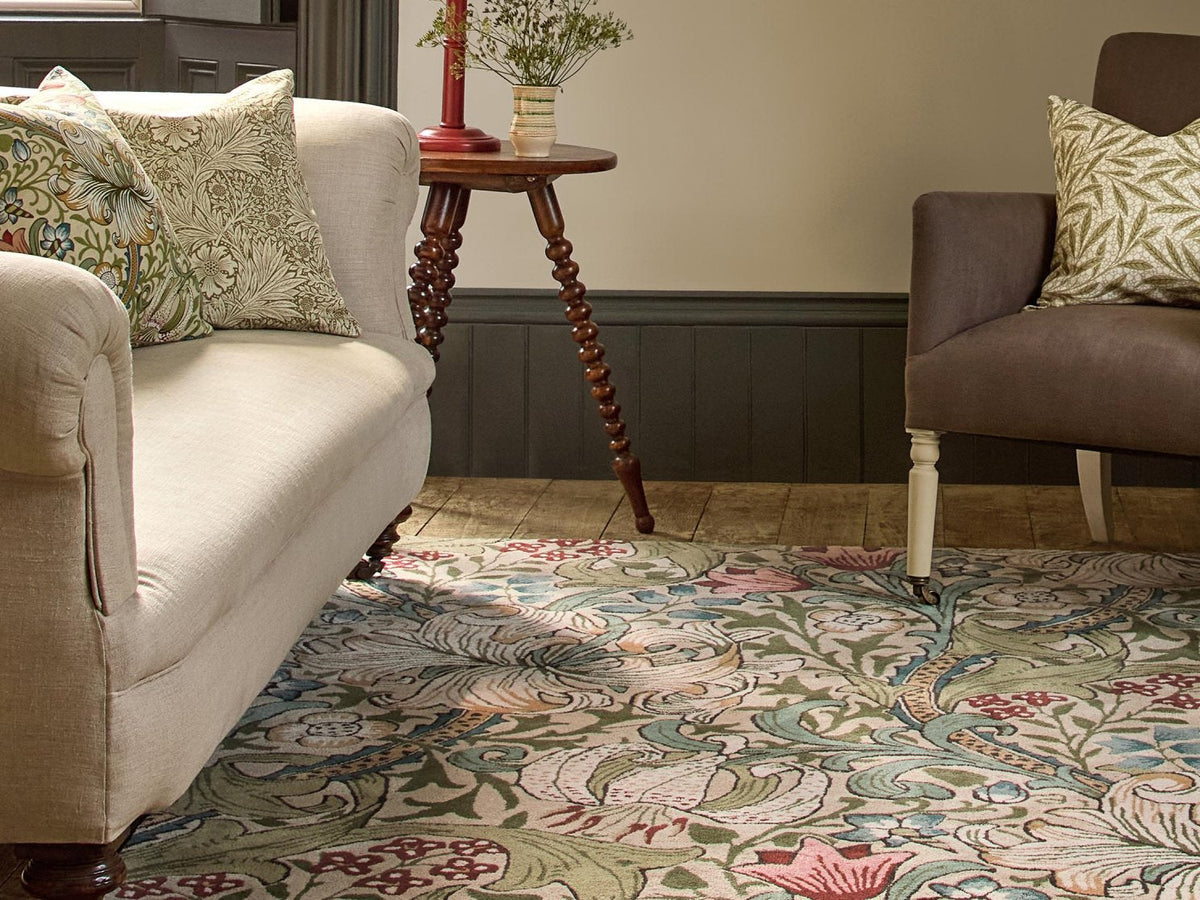
Many of the designer rugs we carry are hand-tufted in pure new wool, including the Morris & Co range. Golden Lily in Green and Red, drawn in 1899 and still in production, has a 12 mm cut pile with real depth underfoot, and its dense, all-over pattern is the classic partner for a traditional chimney breast.
Getting the size and position right
- Anchor the seating, not the fire. The most successful hearth rugs sit in front of the fireplace and under the front legs of the sofa and chairs, so the whole conversation area reads as one. A rug that floats on its own in front of the fire tends to look like a mat.
- Centre it on the chimney breast. In most period rooms the chimney breast is the axis of the room. Centring the rug on it, rather than on the window or the sofa, keeps everything calm and symmetrical.
- Allow for alcoves. Where there are alcoves either side, measure the full width of the room and decide whether the rug should stop short of them or reach into them. Our guide to choosing a living room rug covers proportions in detail.
Colour and pattern for firelight
Firelight is warm and low, and it changes how a rug looks in the evening. Reds, rusts, ochres and deep greens glow by firelight, while cool greys can look flat. A patterned rug is also kinder to the realities of a working fire: a scatter of ash or a log carried across the room is far less noticeable on a busy design than on a pale plain.
- Traditional rooms suit the scrolling foliage of the Morris & Co collection or a Persian-inspired design with a border to frame the hearth.
- Modern rooms with a stove often look best with a textured plain or a softly mottled design in a mid-tone, which grounds a contemporary stove without competing with it.
- Snugs and dens can take something deeper and more enveloping; our guide to choosing a rug for a snug has more ideas.
Caring for a hearth-side rug
- Brush, don't rub. If ash or soot lands on the rug, let it cool, then lift it with a soft brush or the vacuum nozzle. Rubbing pushes fine particles into the pile.
- Vacuum little and often. A working fire brings a fine dust into the room. A gentle, regular vacuum keeps it from settling deep into the rug.
- Rotate occasionally. The area in front of the fire takes the most foot traffic in winter. Turning the rug a couple of times a season spreads the wear evenly.
- Keep logs off the rug. Store kindling and logs in a basket on the hearth or to one side, never directly on the pile, where bark and moisture can mark it.
For more ideas on making a room feel warmer as the evenings draw in, see our guide to autumn interiors, or browse our full range of living room rugs.
A decorator's note
When we help clients choose a rug for a fireplace wall, we always ask for two measurements: the width of the chimney breast and the distance from the front of the hearth to the front of the sofa. Those two numbers usually tell us the right size straight away. If you send our team a photograph of your room with those measurements, we will happily suggest the sizes and designs that will sit best by your fire.