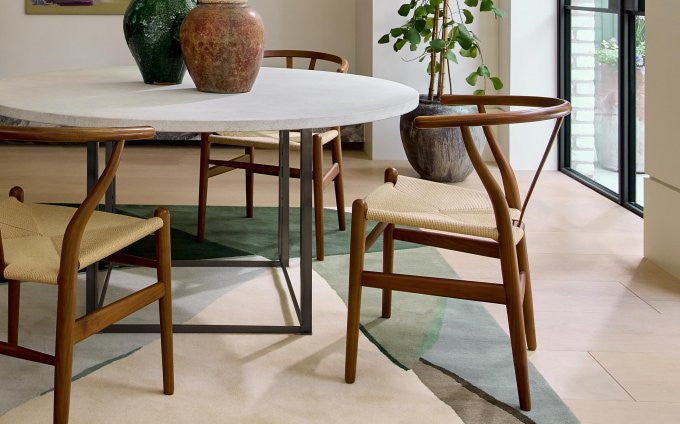
Article: Rugs for Awkward Rooms: Bay Windows, Alcoves and L-Shaped Spaces

Rugs for Awkward Rooms: Bay Windows, Alcoves and L-Shaped Spaces
Rug guides tend to assume a tidy rectangular room with a sofa facing a fireplace. British homes are rarely so obliging. Victorian bay windows, chimney-breast alcoves, sloping loft rooms, L-shaped kitchen-diners and narrow through-rooms all make choosing a rug harder. The good news is that awkward rooms are often where a rug makes the biggest difference.
Bay windows
A bay is a room within a room, and it deserves its own treatment. There are two approaches.
Keep the main rug in the main room. Size the rug to the rectangular part of the room and let the bay stand on its own with a chair, a desk or a window seat. This is usually the cleaner solution.
Give the bay its own rug. A round rug sits beautifully in a curved or angled bay, echoing its shape and creating a reading nook or small dining spot. Read more in our guide to round rugs.
What to avoid is a rectangular rug pushed half into the bay, which tends to look as though it has slipped.
Alcoves and chimney breasts
In a typical period living room with a chimney breast, centre the rug on the fireplace rather than on the room. The fireplace is the natural focal point, and the room will feel balanced even if the alcoves are different depths. Our guide to rugs for period properties covers this in more detail.
L-shaped rooms
An L-shaped room is really two zones that share a corner. Resist the temptation to find one rug to cover both. Instead, use two rugs to define each area, typically a larger one for the living zone and another for dining or a study corner.
- Keep the rugs from the same colour family, or share one colour between them, so they feel related.
- Vary the pattern or texture so they do not look like a matching set.
- Leave a clear strip of floor between them. It helps each zone read as its own space.
The same principles apply to open-plan spaces; see our guide to open-plan living.
Long, narrow rooms
In through-rooms and galley spaces, a single long rug can exaggerate the tunnel effect. Two or three rugs placed along the length break it up and create distinct areas. In very narrow spaces, a runner is often the answer.
Square rooms
A square room can look boxy with a rectangular rug. A square rug or a large round rug suits the proportions better, particularly under a central table or seating group.
Sloping ceilings and loft rooms
In attic rooms, place the rug where you can stand up comfortably, usually in the centre under the ridge. Low eaves are best left for storage or a low bed. Choose a lighter colour to make the most of the limited light.
When nothing fits: made to order
Sometimes a room simply needs a size that is not standard. Many of our designs can be made to measure, which is often the best answer for unusual proportions, stair landings and large period rooms. Explore our custom and made-to-order rugs.
A decorator's note
Before ordering, mark the rug's outline on the floor with masking tape and live with it for a day or two. In an awkward room, this simple test tells you more than any measurement. For standard sizing, our complete UK rug size guide is the place to start.