Rugs on Stone, Tile and Concrete Floors: Warmth, Grip and Protection
Stone and tile floors are a joy in summer: cool underfoot, easy to mop and handsome in a kitchen, hallway or garden room. Polished concrete has become just as popular in modern extensions. Come November, though, the same floors can feel cold to bare feet, make a room echo and look a little stark. A rug is the simplest answer, but hard mineral floors bring their own considerations. We have already covered rugs on wooden floors; this is the companion guide for flagstone, tile and concrete.
Why these floors feel so cold
Stone, ceramic and concrete are dense materials that draw warmth away from your feet far more readily than timber or carpet. Even in a heated room, a tiled floor can feel chilly to the touch. A rug puts a layer of fibre between you and the floor, and a dense wool pile is especially good at this.
If your stone or tiled floor is heated, the rules change slightly: you want warmth to rise through the rug rather than be trapped beneath it. Read rugs and underfloor heating before you buy.
Grip: the first priority
Smooth tiles and polished concrete give a rug very little to hold on to. A rug that creeps or rucks is not only annoying but a genuine trip hazard, particularly in kitchens and hallways.
- Use an underlay: a good underlay holds the rug in place and adds a little cushioning. Browse our underlay, and read Rug Underlays: The Layer Nobody Sees.
- Size it to the furniture: a rug held down by the front legs of a sofa or a table and chairs moves far less than one floating on its own.
- Keep edges flat: curled corners catch toes and feet. Our guide to stopping a rug slipping on hard floors has more practical tips.
Protecting rug and floor alike
Grit is the hidden enemy on a hard floor. Fine particles trapped between a rug and stone act rather like sandpaper, wearing the back of the rug and dulling a polished surface. Sweep or vacuum the floor beneath the rug whenever you clean, and an underlay helps here too.
In older houses with original flagstones, it is also worth checking that the floor is dry. Some traditional floors were laid without a damp-proof membrane, and a rug left in place for months on a floor that draws moisture may stay damp underneath. Lift the rug from time to time, let the floor and the back of the rug air, and seek advice if you notice a musty smell or marks on the stone.
Choosing the right rug
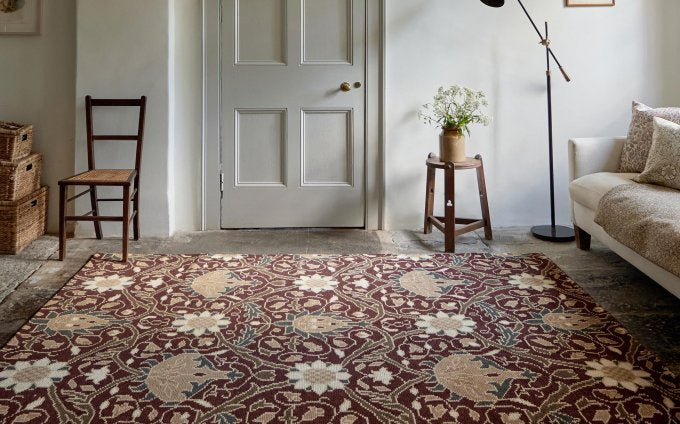
- Kitchens and hallways: low profiles are easiest, clearing doors and taking chair legs without fuss. Morris & Co's Montreal in Russet, pictured, is a hand-knotted wool flatweave of about 7 mm. Kelims and other flatweaves work in the same way.
- Boot rooms and back doors: where mud and wet paws are part of daily life, a washable rug takes the pressure off.
- Living spaces: in a sitting room or snug with a stone or concrete floor, a generous wool pile adds the softness and warmth the floor lacks.
Quietening a hard room
Stone, tile and concrete reflect sound, which is why a kitchen-diner or open-plan extension can feel noisy. A large rug is one of the most effective ways to soften that echo. Our guide to rugs and acoustics explains how.
Colour against stone and concrete
Cool grey concrete and pale limestone can make a room feel chilly visually as well as physically. Warm tones such as rust, ochre, terracotta and russet balance that coolness beautifully, while a deeper rug against pale tiles gives the room a clear anchor. Terracotta and quarry tiles, already warm, often look best with cream, sage or soft blue.
A decorator's note
Hard floors and rugs are natural partners: the floor brings durability and the rug brings comfort. The secret is grip, a little airflow and a construction that suits the room. If you are not sure which rug or underlay will suit your stone, tile or concrete floor, send our team a photograph and we will happily advise.