Article: Marimekko Rugs: Unikko, Kivet and Finnish Pattern Underfoot
Marimekko Rugs: Unikko, Kivet and Finnish Pattern Underfoot
Marimekko is one of the great names in twentieth-century design. Founded in Finland, it became known for bold, joyful prints drawn by hand and repeated at a scale few other textile houses dared. The Marimekko rug collection, produced by Brink & Campman, brings several of those famous patterns to the floor, from Maija Isola's poppy to the brick grid designed by the company's founder, Armi Ratia. Browse the full Marimekko collection.
Unikko: the poppy
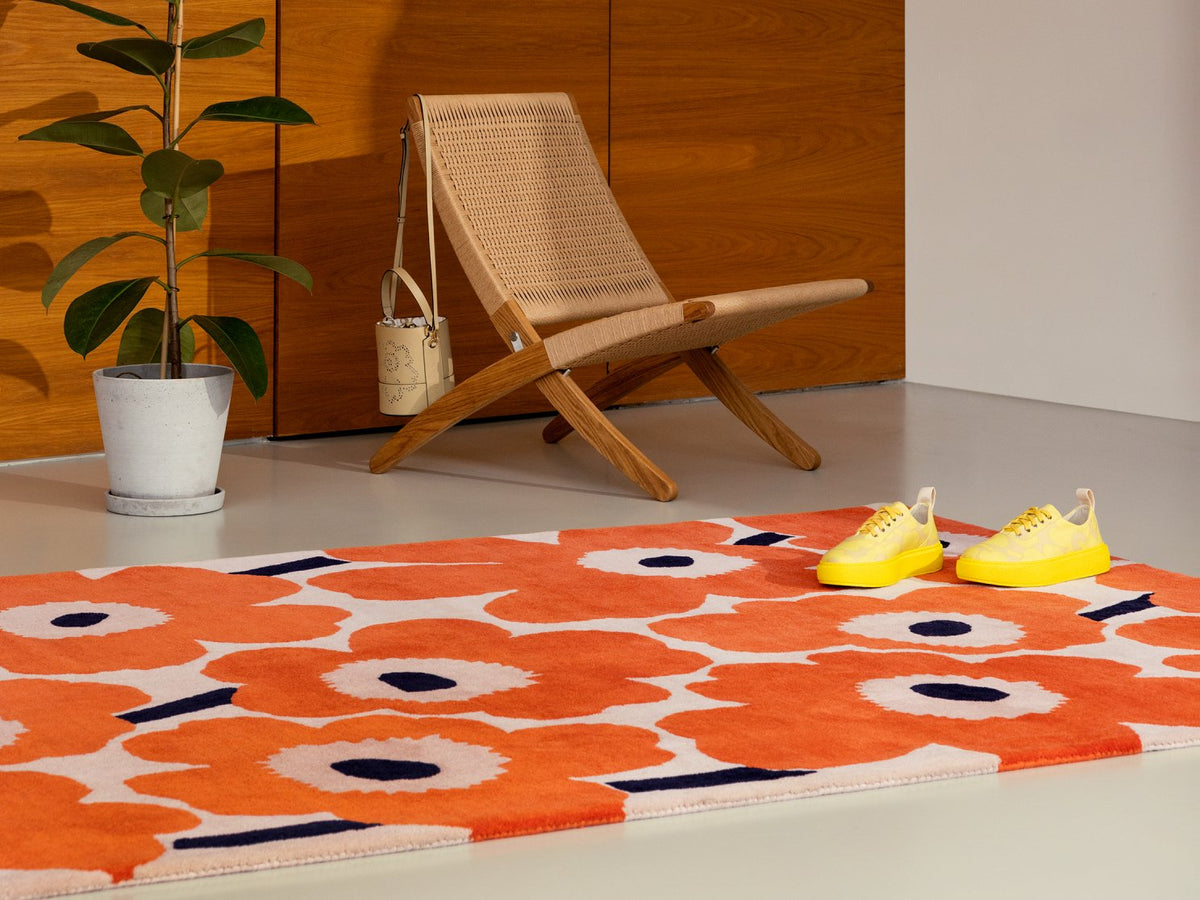
Unikko is the pattern most people picture when they think of Marimekko. Maija Isola painted it in 1964, after Armi Ratia had banned flower patterns, and it has since become one of the most recognisable prints in the world. On the floor it appears in several guises:
- Classic Unikko, such as Orange Red, with big poppies and cream-and-black centres on an ivory ground. Greige is the neutral version and the easiest to fit into an existing scheme.
- Tonal Unikko, such as Dark Green or Burgundy, where the flowers are worked tone on tone so the rug reads almost as a plain colour from across the room.
- Iso Unikko (big Unikko), scaled up so only a few flowers fill the whole rug.
- Piirto Unikko, which Marimekko describe as an airy, stylised variation that strips the poppy back to its drawn outline.
Kivet: the stones
Isot Kivet means big stones. Marimekko explain that Maija Isola built the design from circles cut with scissors, probably inspired by the rough-edged stones cleared by hand from the grounds of her atelier home. It is available in strong colourways such as Blue and Green, and in Natural White, where the circles are carved into the ivory ground as soft relief.
Tiiliskivi: the brick
Tiiliskivi means brick, and the pattern was designed by Armi Ratia in 1952. Marimekko say it reflects her belief in the simple beauty of everyday life. It is a disciplined, almost architectural design that suits modern interiors well, from the earthy Brown to the crisp outline of Bright Blue on a warm sand ground.
Waves and stripes
- Lokki (seagull) came to Maija Isola, Marimekko tell us, while looking at a curtained window on a sunny day, where the folds formed wavy shadows. The rug has four broad rows of those waves; Black is the most graphic version.
- Seireeni, Isola's 1964 print, was inspired by the movement of water she saw while travelling in Greece. One huge wave curves down the rug.
- Kalasääski (osprey) is a freehand pattern of vertical and diagonal stripes, available in warm Brass, soft Greige and Light Green.
Indoors and out
Several designs, including the Unikko Anniversary version created for the print's 60th anniversary in 2024, are also available in an indoor/outdoor range tufted from yarn spun from recycled PET bottles. These are a good choice for terraces, garden rooms and hard-working spaces; see our outdoor rugs collection.
How to style a Marimekko rug
Give it room. Marimekko patterns are designed at a generous scale. A large rug lets the motif repeat properly; a small one can crop it awkwardly. Our rug size guide will help.
Keep the furniture simple. Clean-lined pale wood, white walls and plain upholstery let the pattern do the talking, in the Nordic tradition. Our guide to Japandi and Scandinavian interiors explores this look.
Choose tonal versions for calm rooms. If a full-colour Unikko feels too bold for a bedroom, a tonal colourway gives you the design without the volume. For more on using a bold piece well, see how to style a statement rug in a neutral room.
A decorator's note
The same Marimekko design can feel completely different from one colourway to the next, from exuberant to almost minimal. If you love a pattern but are unsure which version suits your room, send our team a photograph and a note of your colours, and we will happily help you choose.